- The IT department IT i forskning, formidling og utdanning (FFU)(NO), or Division for Research, Dissemination and Education (RDE)(EN), is responsible for delivering IT support for research at University of Oslo.
- The division's departments operate infrastructure for research, and support researchers in the use of computational resources, data storage, application portals, parallelization and optimization of code, and advanced user support.
- Announcement of this newsletter is done on the hpc-users mailing list. To join the hpc-users list, send a mail to sympa@usit.uio.no with subject "subscribe hpc-users Mr Fox" (if your name is Mr Fox). The newsletter will be issued at least twice a year.
Summer is over and we're getting ready for an exciting fall semester. Large language models are still the thing in the AI world, but we are now seeing more and more efforts put into training models for Norwegian use cases and to host and provide models on Norwegian soil. This of course directs the spotlight at us HPC guys sitting in a corner with lots of strange and costly hardware accelerators that accidentally are ideal for doing all those computations needed to provide cat videos and vibe code (and also some more useful stuff). Of course, we are happy to provide access, and even more happy to help procure and install more hardware to cover the increasing needs from research and education and even public administration - at least as long as our researchers still get their needs fulfilled. However, seeing how this technology changes a lot in how we work and accelerates not only our daily tasks but also the ways in which we can break things, it is clear that we also need to provide training and recommendations so that we can use the expensive hardware and powerful tools as safely and efficiently as possible.

New Colossus
The upgraded Colossus was set in production mid-May. Like Olivia, it now has both gpu-hour as well as cpu-hour quotas.
Every TSD project receives a default quota (per 6 month period) of 4000 CPU billing hours and 300 GPU hours to automatically enable TSD autotekst access. It also automatically enables job scheduling via the tsd-hpc-api. For job submission via the command line (i.e. "sbatch") a submit host ("pXX-hpc-01") can be requested by contacting TSD.
Each project can request more quota or increased priority. For quota up to 100,000 CPU billing hours and/or 10,000 GPU hours project administrators can contact TSD. For quota greater than 100,000 CPU billing hours or greater than 10,000 GPU hours an application should be submitted to Sigma2.
All CPU billing hours and GPU hours usage is reported to Sigma2. UiB, UiO, UiT, NTNU (BOTT) have institutional agreements with Sigma2 to cover for service usage (compute, storage) used by its researchers. This now covers Colossus usage too. This means that for BOTT-affiliated projects any costs are covered centrally via the institutional agreements. For non-BOTT affiliated projects, the costs are covered under UiO's institutional agreement (if within acceptable limits). Some non-BOTT affiliated projects may have their own institutional agreements to cover for extended quota. If in doubt, please contact Sigma2 directly.
Warewulf Cluster Management
Since launch, Fox has used xCAT for provisioning - the same system as Fram, Saga and Colossus. It served us well, but xCAT has been around since 1999 and is showing its age. We've been looking for a replacement, and a clear favorite emerged with Warewulf (WW) v4, which was rewritten from the ground up with a notably different design philosophy.
From Titan (UiO's first "modern" Beowulf cluster) through Abel, Colossus and Fox, we've always done "diskful" installs: automatically installing and configuring the OS to disk, like a normal server. We'd prepare an installation scheme (a "dist") and either reinstall nodes with it or semi-manually patch running nodes.
This works, but has drawbacks. It's slow - formatting drives, running the installer, and configuring can take 30+ minutes per node, which adds up even in the ideal situation of being able to reinstall all the nodes at once. It's also stateful: changing a package or config means either reinstalling every node (accepting temporary inconsistency as nodes trickle through) or pushing changes with a config management tool and only reinstalling occasionally. Neither is perfect.
Warewulf takes a diskless and stateless approach by default. Instead of running an OS installer, nodes boot directly from a prepared image, as if it were the hard drive - cutting boot time from 30+ minutes to about 5. Using kexec, we can even warm-boot nodes into a new image in under a minute. And for simple file changes, we don't need to touch the image at all - Warewulf's overlay system lets the WW client pull config files from a central store and apply them automatically.
So our old workflow - "prepare new dist, test it, patch running nodes if needed, reinstall when possible" becomes with WW4: "update the image, test it, run a command to apply," or for simple changes, just "edit the file and wait a minute or two."
We've been running WW4 on Colossus since its renewal this spring, and now it's Fox's turn. We'll do our best to keep downtime and disruption minimal - if all goes well, you might not even notice.
New Norwegian Language Model "Borealis" Launched
On August 10, the National Library of Norway launched the new Norwegian language models in the Borealis series. For the first time, copyright-protected content from Norwegian newspapers has been used for both foundational training and fine-tuning of models in Bokmål and Nynorsk, ensuring that Norwegian media houses are compensated for the use of their content. The goal is to provide both the public and private sectors with safe, up-to-date, and ethically grounded AI models for the Norwegian language.
Through the NRIS (Norwegian Research Infrastructure Services) collaboration, we have contributed with infrastructure for the development of the models. The heavy computational work for training and testing has been run on the GPU nodes on Norway's most powerful supercomputer, Olivia and the inference service has been hosted on the NIRD Service Platform.
It is nice to see that the national e-infrastructure plays a central role in the development of Norwegian artificial intelligence!
You can read more about the new models and the launch event at the National Library's website.
LLMs and HPC
GPT UiO, our GDPR compliant AI chat service, continues to be improved, including support for open‑weight LLMs running in Idun at NTNU and Educloud here in Oslo.
Support for red (in confidence) data with selected models was added this spring. This has been a much requested capability, which we are now very happy to be able to offer.
The quality and variation of the available open‑weight models continue to improve. We pay particular attention to Norwegian language models and prioritize including a selection that meets our requirements for reliability and performance.
This fall, API support through gpt.uio.no with personal access tokens, for both open‑weight and commercial models, is being rolled out gradually with per‑user quotas. Looking ahead, we plan to offer API usage with higher individual quotas for commercial models later in 2026, including billing of usage to UiO departments and support for Anthropic Claude models.
Other hardware needs
With the ongoing turmoil about computing architectures we are also looking into RISC-V. The European Processor Initiative is aiming for ARM and RISC-V and UiO needs to stay on top of things. We do not have RISC-V available today, but if we see a demand for testing and gaining experience we will consider procuring some samples. Call out if this sounds interesting.
New Sigma2 e-Infrastructure allocation period 2026.2, application deadline 26 August 2026
The Sigma2 e-Infrastructure period 2026.1 (01.10.2026 - 30.04.2027) is getting nearer, and the deadline for applications for HPC CPU hours and storage (for both regular and sensitive data), is 26 August. This also includes access to the Sigma2 part of TSD (Colossus and storage), as well as LUMI-C and LUMI-G.
Please note that although applications for allocations can span multiple allocation periods, they require verification from the applicants prior to each application deadline to be processed by the Resource Allocation Committee for a subsequent period. Hence any existing multi-period application must be verified before the deadline to be evaluated and receive an allocation before the new period starts. This does not apply to LARGE projects.
Kind reminder: If you have many CPU hours remaining in the current period, you should of course try to utilize them ASAP, but since many users will be doing the same there is likely going to be a resource squeeze and potentially long queue times. The quotas are allocated according to several criteria, of which publications registered to Cristin is an important one (in addition to historical usage). The quotas are based on even use throughout the allocation period. If you think you will be unable to spend all your allocated CPU hours, it is highly appreciated that you notify sigma@sikt.no so that the CPU hours may be released for someone else. You may get extra hours if you need more later. For those of you that have run out of hours already, or are about to run out of hours, take a look at the Sigma2 extra allocation page to see how to ask for more. No guarantees of course.
Run
projects
to list project accounts you are able to use.
Run
cost -p nn0815k
to check your allocation (replace 0815 with your project's account name).
Run
cost -p nn0815k --detail
to check your allocation and print consumption for all users of that allocation.
KI-fabrikken

KI-fabrikken continues to lower the threshold for adopting artificial intelligence across research, industry and the public sector. Several developments now make the initiative easier to access and better connect to the wider Norwegian AI community.
KI-fabrikken now has a dedicated landing page that brings its services together in one place, from introductory guidance and courses to expert consultations, so that experienced HPC users and newcomers alike can find what is relevant to their work.
At the national level, a new collaboration arena for artificial intelligence, funded by the Research Council of Norway, will connect research, industry and the public sector. Sigma2 takes part alongside NORA, Digital Norway and KI Norge, with contributions from NTNU, NHH and Innovation Norway.
Together, these steps reflect KI-fabrikken's ambition to make AI more accessible while ensuring a safe and ethically sound environment for its development.
Read more about the arena and the partnership behind it: https://digitalnorway.com/aktuelt/norge-far-ny-nasjonal-samspillsarena-for-kunstig-intelligens
For service offerings and details: https://www.sigma2.no/nb/ki-fabrikken
Upcoming Workshops and Trainings
CodeRefinery Workshop: Git, GitHub and Collaborative Coding
Improve your research software development skills with the upcoming CodeRefinery workshop, starting 22 September 2026. The workshop covers practical tools and workflows for version control, collaborative coding, reproducible research, and sustainable research software development.
A great opportunity for researchers, developers, and HPC users who want to improve how they develop, manage, and collaborate on research code.
This course is ideal for researchers who write code as part of their work and want to:
- Learn version control with Git and GitHub
- Improve the reproducibility of their research
- Write better-documented and more maintainable code
- Use testing and modular design to avoid common pitfalls
Workshop Format:
The workshop is held online, but you are welcome to join our DSC in-person session if you would like hands-on help, as well as coffee and snacks.
The workshop is free to join, but please register your attendance.
Course details and registration - UiO
Digital Scholarship Days @UiO
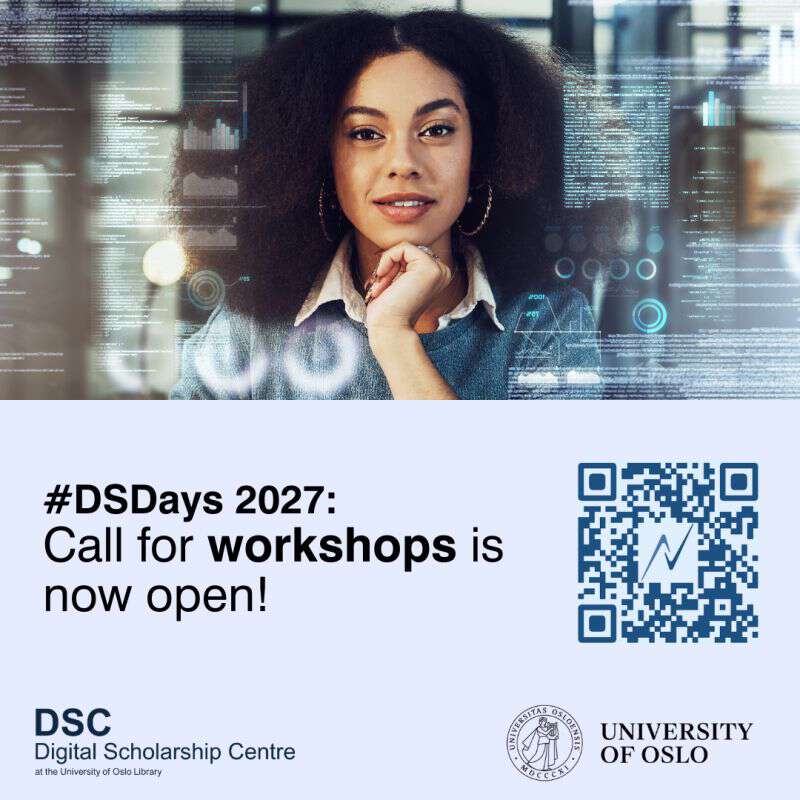
Digital Scholarship Days is an annual event designed for students and researchers who want to expand their knowledge of digital methods and tools, generative AI, machine learning, open research, research data management, and much more!
The 2027 edition of Digital Scholarship Days will take place from January 5 to January 8, 2027.
Proposals are welcome from researchers (at any career stage), engineers, librarians, administrative staff, and anyone interested in sharing their knowledge and skills with colleagues. Sessions should be interactive and hands-on.
Pitch your workshop idea here: DSDays27 Proposal Form

With the increasing importance of e-infrastructure in various fields of research, public administration and industry, NRIS (Norwegian research infrastructure services) has a central role in providing training opportunities for Norwegian user groups.
All courses are open to all participants and free of charge, but registration is mandatory. Below is a list of upcoming events provided by the NRIS Training Team:
NRIS: HPC Onboarding course
Are you a new user of the national HPC-systems? If yes, we highly recommend this 3 half days onboarding hands-on course, organised by NRIS.
Date and time:
- Start: Oct 13 2026 09:00
- End: Oct 15 2026 12:30
Course details and registration
The Parallel Computing with Python on Olivia course series
In this course series, NRIS training team will guide you through practical steps and hands-on tasks to help you gain experience with parallel computing on Olivia using Python. Parallel computing can be divided into the following levels:
- Code Optimization – Techniques to speed up Python code on a single CPU core.
- Vector-Threading – Performing parallel computations within a single CPU core.
- Multi-Threading – Parallel computing across multiple CPU cores on a single node.
- Multi-Tasking – Executing parallel computations across multiple nodes (or within a single node).
- Hybrid Parallel Computing – Combining multi-threading and multi-tasking for maximum efficiency by leveraging all levels of parallelism..
Practical Information:
When: The course series happens 6 consecutive Wednesdays, starting from Wednesday Sept. 2nd until Oct. 7th 2026.
Course details and registration
The Fox cluster is the 'general use' HPC system within Educloud, open to researchers and students at UiO and their external collaborators. Access to Fox requires having an Educloud user, see registration instructions.
For instructions and guidelines on how to use Fox, see our HPC documentation.
Software request form
If you need additional software or want us to upgrade an existing software package, we are happy to do this for you (or help you to install it yourself if you prefer that). In order for us to get all the relevant information and take care of the installation as quick as possible, we have created a software request form. After filling in the form, a ticket will be created in RT and we will get back to you with the installation progress.
To request software, go to the software request form.
Support request form
We have had great experience with users requesting software installations since we introduced the software request form. We now usually get all the information we need at first contact. We want to further improve our support and get to the root cause of an issue faster. Therefore we now encourage you to fill in a form when you need help with other types of issues as well. When the support form is submitted it will be sent to our hpc-drift queue in RT and will be handled as usual. The difference from emailing us directly is that we will now immediately get needed bits of information and your tickets will be labelled according to what system you are on and what issue you are facing.
The link to the new support form will be shown when you log in our servers and it has also been added to relevant documentation pages. You can have a look at it here:
https://nettskjema.no/a/hpc-support
We encourage users of all our HPC resources to use this form. Whether it concerns Fox, LightHPC, ML-nodes, Educloud OnDemand, Galaxy-Fox or our individual appnodes.
Publication tracker
The Division for Research, Dissemination and Education (RDE) is interested in keeping track of publications where computation on RDE services are involved. We greatly appreciate an email to:
hpc-publications@usit.uio.no
about any publications (including in the general media). If you would like to cite use of our services, please follow this information.
Werefox, the Werewolf's cousin