The plan was always to study astrophysics. Everything else was coincidence. My name is Rebecca, and I am a Master's student in Astrophysics at the Institute of Theoretical Astrophysics.
Meet Rebecca, a Master's student in Astrophysics at the Institute of Theoretical Astrophysics, University of Oslo. She is also active on social media, where she shares insights into astrophysics and student life. Photo: Private.
By
Rebecca Nguyen
PublishedJuly 3, 2026
This article was first published February 2026, and has been translated using Copilot.
Alongside my studies, I also communicate science on social media through my Instagram account, @astrofystrikker. This is the story of how I ended up exactly where I am today.
My first encounter with astrophysics
The first coincidence, which shaped a large part of who I am, occurred when I was eleven years old. It was my very first encounter with astrophysics. I had just finished Year 6, the summer holidays had finally begun, and learning certainly did not stop for me simply because school was out.
My parents had enrolled me on a Summer School course called Through the Telescope, and during that week we visited the Observatory at Solli plass. Suddenly, eleven-year-old Rebecca found herself surrounded by enormous telescopes in a magnificent building designed for observing the night sky.
That day planted a curiosity about the mysteries of the universe, which would blossom years later.
Writing my master's thesis
Fifteen years later, I am now in the final year of a Master's degree in Astrophysics. My thesis is in the field of solar physics, and I am analysing observations of the Sun taken with the Swedish Solar Telescope on La Palma.
I am working to characterise and understand a phenomenon known as Ellerman bombs, named after the American astronomer Ferdinand Ellerman. These are small, short-lived brightenings that occur all across the Sun's surface. To me, they resemble tea-light flames viewed from the side. On their own, Ellerman bombs cannot answer the major questions in solar physics, but they do provide valuable insight into the behaviour of the Sun's magnetic field.
I genuinely love what I do, but for a long time I could not understand why anyone would care about the Sun.
Of everything in space, the Sun seemed like the least exciting object. Yet I ended up here thanks to a summer job at the Rosseland Centre for Solar Physics (RoCS) in 2024.
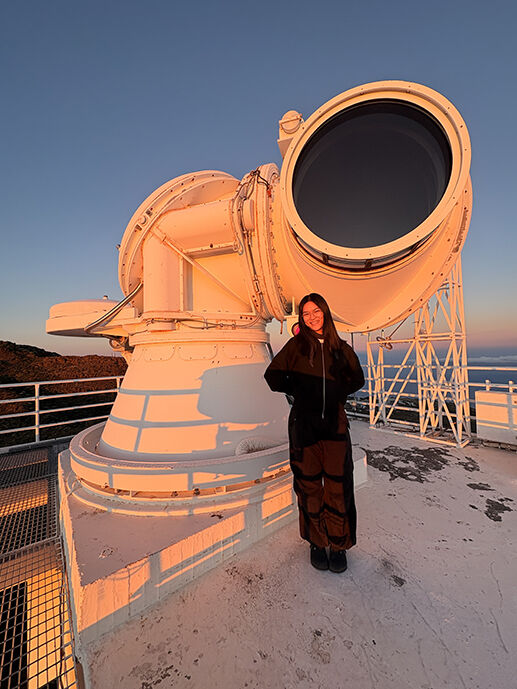
Rebecca Nguyen at the Swedish Solar Telescope on La Palma. Photo: Aline Rangøy Brunvoll.
Rebecca Nguyen at the Swedish Solar Telescope on La Palma. Photo: Aline Rangøy Brunvoll.
The summer job that left me wanting more
The second coincidence came the summer before I started my Master's degree, when I was offered a summer position at RoCS. For six weeks, I worked on a project entitled Detection and Classification of Ellerman Bombs in Solar Observations Using Deep Learning.
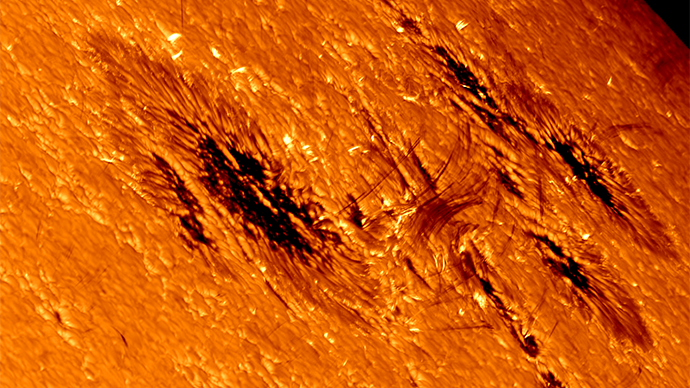
An active region of the Sun observed with the Swedish Solar Telescope on La Palma, 24 May 2024. The Ellerman bombs are the small white flame-like features near the sunspots. Image: SST/RoCS/UiO.
I did not have particularly high expectations of the job beyond gaining relevant work experience and earning some money.
By the end of the summer, however, I was eager for more. I had been given a glimpse of how researchers work.
I had conducted my own analysis of observational data. I had barely scratched the surface. There were questions I wanted to answer. Quite simply, there was more I wanted to achieve, but my time had run out. So I asked whether the summer project could be developed further into a Master's thesis.
Great supervisors make all the difference
Now that my days consist entirely of Master's research, I have the opportunity to immerse myself fully in the world of solar physics. The greatest challenge has been identifying Ellerman bombs in observational data. Although I worked with a tracking algorithm during my summer project, I rebuilt everything from scratch for my thesis.
There is only so much you can accomplish in six weeks, but I carried those experiences with me.
I spent three months developing the tracking algorithm before it was good enough to be used in answering scientific questions about the Sun. Admittedly, lately more new questions have appeared than have been answered. That is where my supervisors come in.
Having excellent supervisors with whom you work well makes an enormous difference.
The astrophysicist who became a STEM influencer
The third coincidence was science communication and social media.
I have been involved in face-to-face science communication since 2021. I have worked at the Solar Observatory in Harestua, Simula, and now at the Observatory at Solli plass - the very place where it all began.
It was not until 2024 that I was introduced to visual science communication on social media through the University of Oslo Norwegian-speaking course Communication and Science Journalism (MNKOM3000/4000). I created my very first Instagram Reel as part of that course and found it incredibly enjoyable.
I then began exploring this new world on my own. At first, I shared aspects of student life on social media - the unfiltered reality, with all its highs and lows. Both the days when everything goes according to plan, and the results come as hoped, and the days when I feel burnt out and want to tear my hair out.
After that, I challenged myself to take concepts from astrophysics and explain them on social media - a format in which you have perhaps six seconds to convince someone not to keep scrolling.
My content is broad and varied, but the common thread is simple: astrophysics explained in an accessible way.
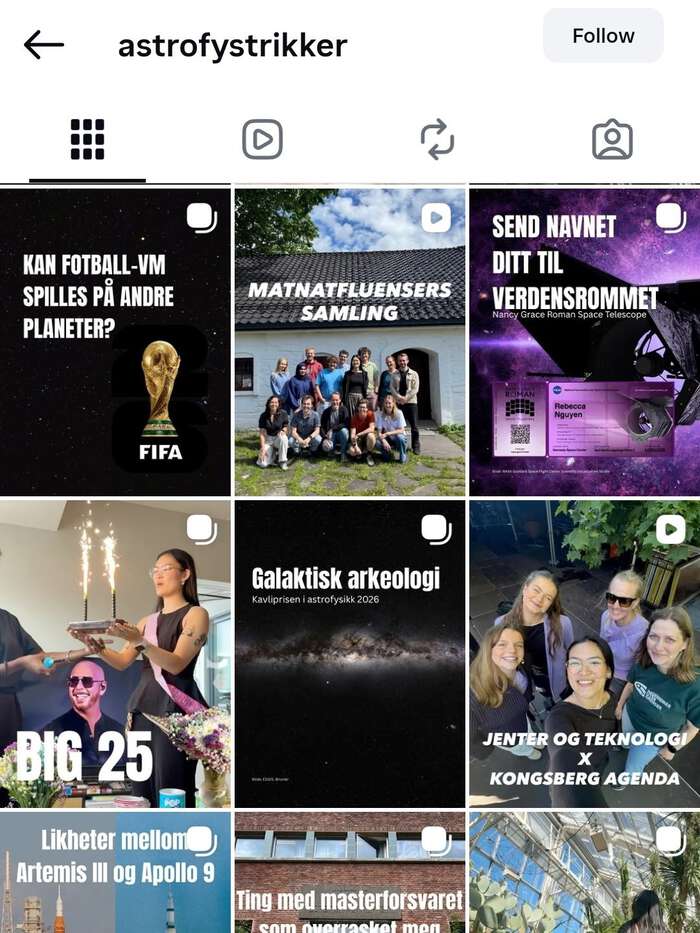
A glimpse into my account.
The response
The response to my content on Instagram has been incredibly positive.
I receive comments and private messages from people who find what I share fascinating and who are learning things they never knew before.
Students often relate to what I share about university life, particularly the difficult days. I have also received questions about studying astrophysics and the entry requirements involved.
Many people from countries including Norway, Morocco, Italy, the United States, and South Africa have expressed interest in studying at the University of Oslo.
Looking back
To sum it all up: none of what I am doing today was entirely planned.
I knew I was interested in astrophysics, and I chose to follow that path. Along the way, opportunities appeared, and I decided to explore them further. That journey has brought me to where I am today.
There is a quote that captures it perfectly:
Shoot for the moon. Even if you miss, you'll land among the stars. - Norman Vincent Peale
-3.jpg)