The Interdisciplinary Facilitator Programme (TFP) builds on the Learning Assistant Programme’s principles of being closely integrated with the course, providing pedagogical training through regular meetings throughout the semester, and promoting active teaching. In addition, the TFP has developed four core areas of content and learning objectives tailored to interdisciplinary education.
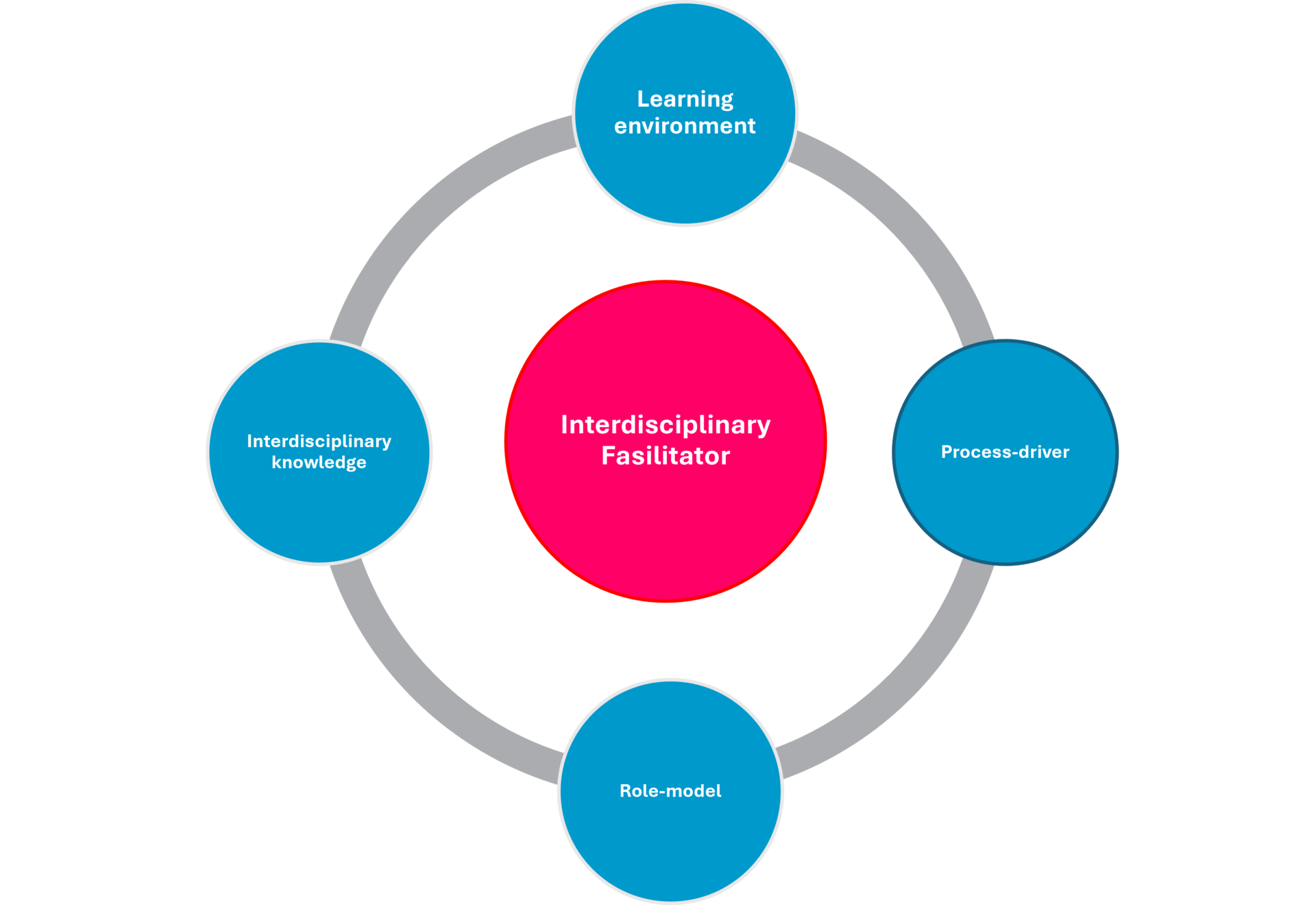
The four core areas are: the learning environment, the facilitator as a role model, interdisciplinary knowledge, and process facilitation.
Interdisciplinary education may have different objectives depending on the course, academic environment, and student group. Facilitators are therefore supported in adapting and delivering learning activities that contribute to achieving the objectives of each individual course.
The Facilitator Programme is currently offered in five programmes:
| Programme/course | Course objectives | Facilitator Programme |
| The Sustainability Certificate | The aim of the Sustainability Certificate is to give students experience in collaborating across disciplines on complex sustainability challenges. Students work in interdisciplinary groups to explore a self-selected sustainability-related issue and develop relevant proposed solutions. | In this programme, facilitators receive support and tools to help students collaborate across disciplines. Students work in groups with diverse academic backgrounds to explore and address a self-selected sustainability-related issue. |
| The Philosophy, Politics and Economics Programme | The aim of the Philosophy, Politics and Economics Programme is to provide students with a foundation for critically reflecting on the relationships between philosophical, political, and economic perspectives. Students explore their own values, positions, and opportunities for action in response to complex societal challenges, and integrate all three perspectives into their bachelor’s thesis. | In this programme, facilitators receive support and tools to guide students in individual reflection and academic inquiry. Students explore how philosophical, political, and economic perspectives can shed light on issues relevant to their own field of study and their bachelor’s thesis. |
| The Climate, Environment and Human Programme | ||
| The Digitalisation Certificate | The aim of the Digitalisation Certificate is to give students insight into how digital technology shapes society, working life, and everyday life. Students develop a fundamental understanding of digitalisation, artificial intelligence, programming, and digital innovation, while also exploring the social and environmental implications of digital transformation. Through interdisciplinary group work, they address a self-selected issue and produce a joint report that examines digitalisation from different disciplinary perspectives. | In this programme, facilitators receive support and tools to help students collaborate across disciplinary boundaries. Students work in interdisciplinary groups on self-selected issues related to digitalisation, while facilitators support the groups in integrating different disciplinary perspectives, developing a holistic understanding of the topic, and collaborating on a joint interdisciplinary report.
|