Abstract
The ODIN project was initiated by the researchers at the Department of Chemistry to support researchers working on the systematic screening of chemical compounds for their potential use as reactants in thin film deposition by Atomic Layer Deposition (ALD). In experiments, different compounds are heated while their behavior is recorded on film. The experiments document how the compounds change during heating. These observations are important for identifying compounds with suitable thermal properties for thin film deposition processes. Each experiment includes not only video recordings, but also a collection of related metadata and numeric analysis outputs. The main goal of this project was to create a web platform where these experimental datasets can be organized, visualized, searched, and downloaded by researchers and other interested users. The resulting application provides both a public-facing interface for browsing published datasets and an authenticated interface for contributors who need to submit new datasets. Users can search the database using unique CAS numbers, chemical names, chemical formulas, or other metadata-based criteria. A key feature of the platform is an interactive periodic table, which allows users to easily search for materials in a way that is natural for chemistry-oriented workflows.
The system was implemented using Streamlit for the user interface and PocketBase as the backend database. Authenticated contributors can upload new datasets, and the submitted data is automatically made available through the visualization interface. The application is currently hosted on the NREC platform, making it accessible as a web-based service. In addition to the graphical web interface, the platform also supports programmatic access through an API, enabling future integration with external tools, scripts, or automated analysis workflows.
Background
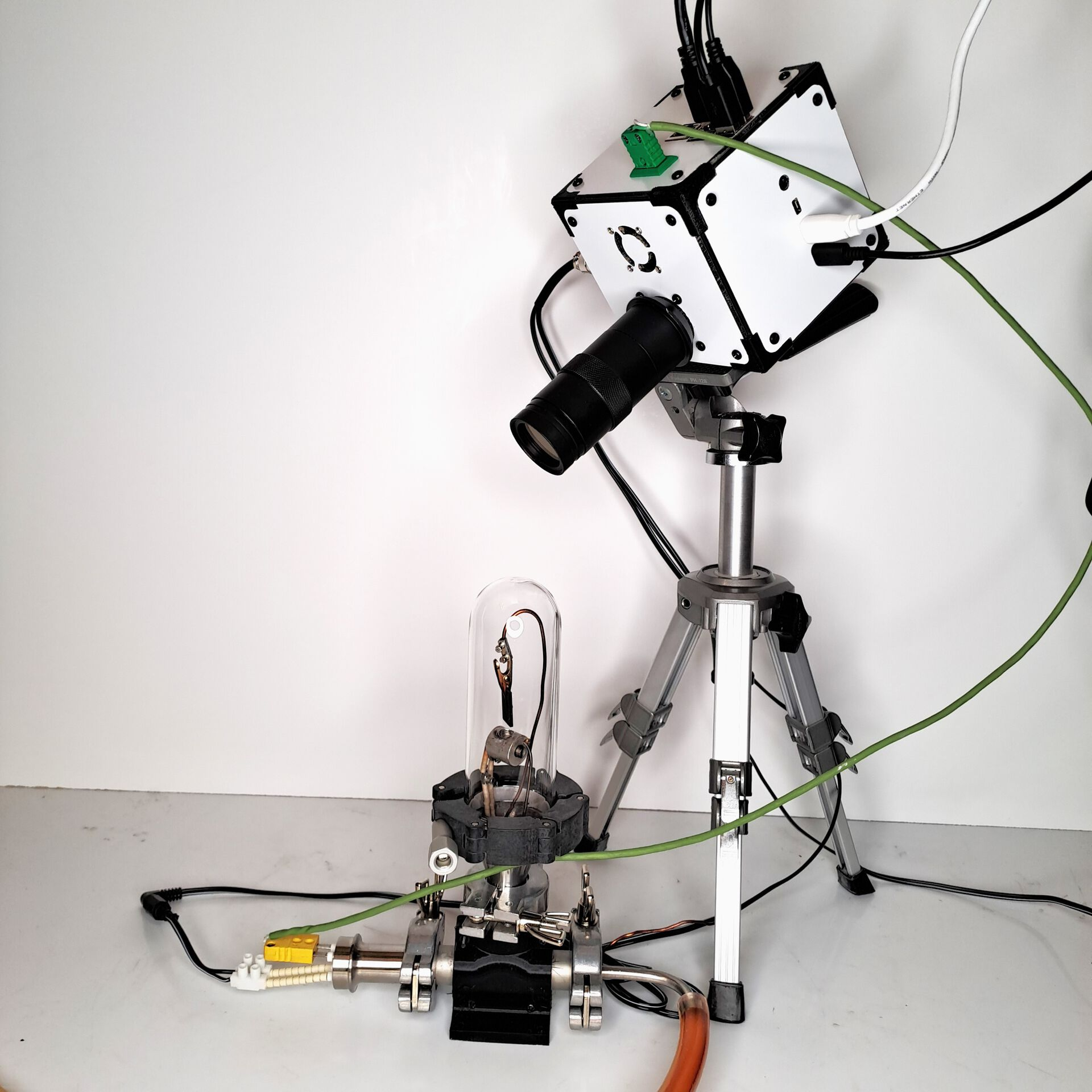
Atomic layer deposition (ALD) is a method used to make very thin films on a surface. It uses gas-based chemical reactions and is related to chemical vapour deposition. A key part of ALD research is finding chemical materials that work well when heated. In this project, chemical samples are filmed during heating to see what happens to them, especially the changes in the RGB color profiles. The experimental setup is shown in Figure 1. The captured video data is combined with ASCII data tables, graphs, and PDF summaries, so researchers can better understand how each sample behaves. It becomes difficult to manage these different types of data using normal folders, spreadsheets, or shared files. Researchers also want to search by CAS number, name, formula, or by other criteria in an easy manner. This created the need for a simple web platform where users can search, explore, upload, manage, and download the data. The project therefore focused on building a practical system that makes the data easier to access and reduces the manual work needed to organize new results.

Methodology
The project was implemented as a web application using Streamlit for the frontend and PocketBase as the backend database. Streamlit was selected because it enables rapid development of interactive scientific web applications using Python, while PocketBase provides a lightweight backend with database storage, authentication, file handling, and API access. This combination made it possible to build a practical solution without introducing unnecessary system complexity. This also enables the end users to make changes easily.
The application supports public access for browsing and searching published datasets without requiring an account. Researchers, collaborators, and other users can inspect available materials, watch experiment videos, view generated plots, and download related data files. The public user interface of the ODIN application is shown in Figure 2. It also supports dataset contributions from authenticated users. Users who wish to contribute can contact the principal investigator, who can create accounts for them in the system. Application admins review and approve submitted datasets before they are published.

A central design requirement was the inclusion of an interactive periodic table. This feature allows users to search the database by selecting chemical elements directly from the periodic table. Most importantly it gives users a familiar visual context and makes the database easier to explore. In addition to this element-based search, the platform supports searching and filtering using CAS numbers, chemical names, chemical formulas, and other metadata fields.
For each dataset submission, the platform stores and presents multiple types of associated information and generates relevant plots from the numerical data. Stored data includes experiment video, JSON files with structured metadata describing the compound and experiment and PDF reports. The plots are generated dynamically when the dataset is viewed. The backend PocketBase database provides authentication and user management. Since PocketBase can expose data through API, the datasets are not limited to the web interface alone. Users or developers can also fetch data programmatically, which opens the possibility for automated analysis, integration with external tools, or future data pipelines.
All scripts and documentation related to this project are available at the github repo https://github.uio.no/dScience/ODIN. The web application is currently hosted on NREC servers at https://odin.uiocloud.no/.