Abstract
The SHAREbrain project was initiated to support researchers working with heterogeneous neuroscience datasets. Such datasets may contain hundreds or thousands of files organized according to local laboratory conventions, project-specific naming schemes, or historical data management practices. This lack of standardization creates difficulties in data sharing, reproducibility, and automated analysis. The research team at the Faculty of Medicine had developed the concept of a Dataset Structure Model (https://github.com/ehennestad/dataset-structure-model), a metadata-aware JSON schema that can describe both the physical layout of a dataset, such as folders and files, and its semantic organization, such as subjects, sessions, and other entities. The long-term goal of the project is to create an automated system that can help users apply this schema to their own datasets by automatically identifying dataset structure, extracting metadata from file paths or file contents, and converting the information into standardized formats.
This work provides a baseline for future development of an AI-assisted dataset curation workflow for SHAREbrain. The prototype can be extended by exposing more parameters in the user interface, supporting prompt editing, testing additional LLMs, integrating agent-based workflows, and evaluating the quality of the generated schema mappings against real datasets.
Background
Modern neuroscience research produces large and complex datasets. These datasets often include imaging files, metadata files, subject information, session information, and outputs from different acquisition or analysis tools. In practice, such data is rarely organized in one universal format. Folder names, file names, metadata conventions, and internal file structures can vary significantly between research groups, instruments, projects, and historical workflows. This heterogeneity makes data curation difficult. Before a dataset can be shared, reused, or analyzed in a standardized way, researchers often need to inspect the folder structure manually, identify subjects and sessions, locate relevant files, and extract metadata from file names, folder names, or file contents. This process can be time-consuming and error-prone, especially when the dataset contains hundreds or thousands of files.
The SHAREbrain project tries to address this challenge by developing solutions like the Dataset Structure Model. This model is intended to describe datasets in a general and flexible way. The key research challenge is not only to define such a schema, but also to help users apply it to real datasets. Manually creating a JSON instance of the Dataset Structure Model for every dataset would still require substantial expertise and effort. The research team therefore wanted to explore whether machine learning and LLM-based methods could assist in this process. The desired long-term workflow is a system, potentially implemented as a set of AI agents, that can inspect a dataset manifest, infer the dataset organization, extract relevant metadata, and produce structured outputs.

Methodology
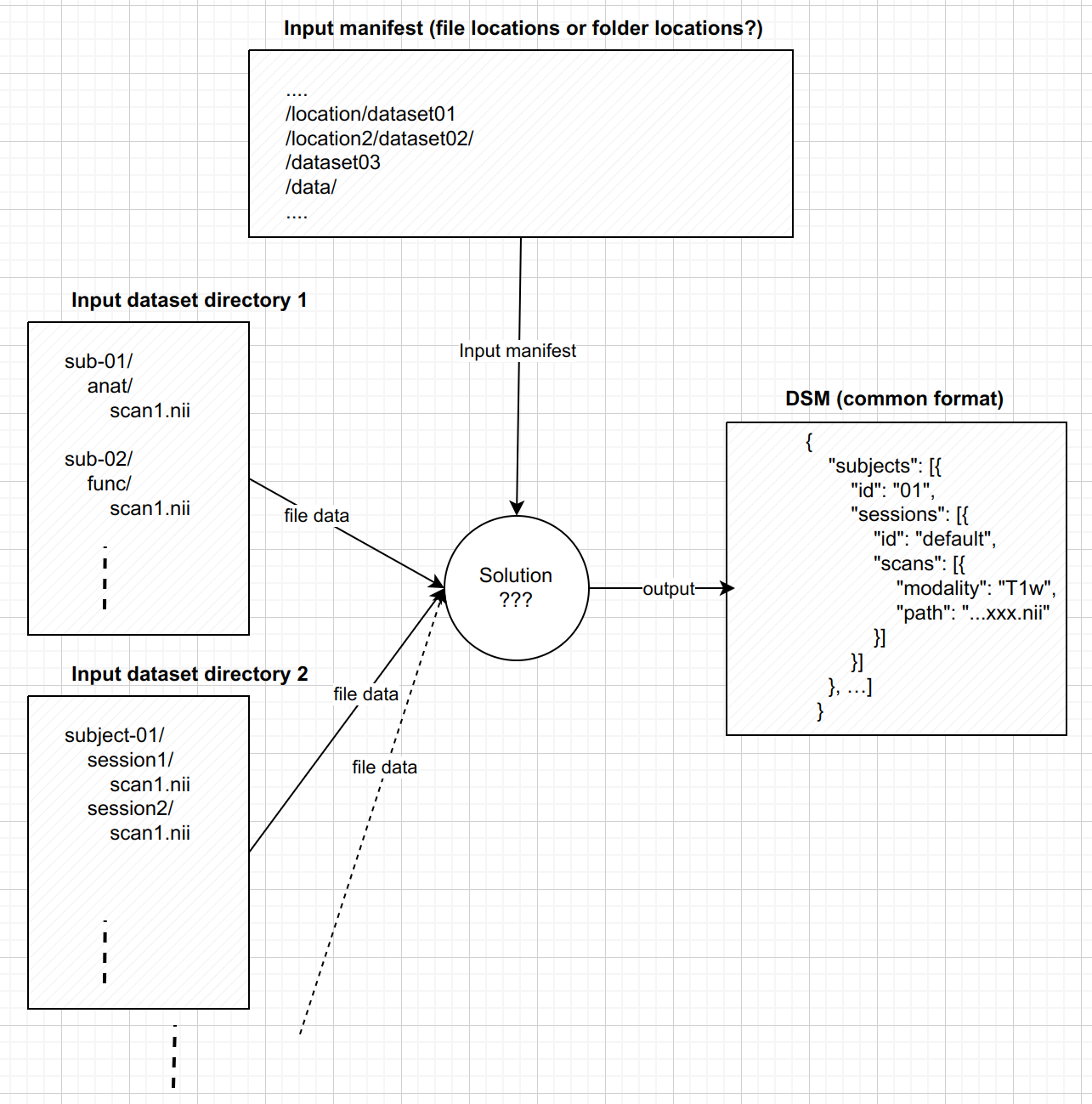
The input to the system is a manifest of file paths representing a dataset, potentially containing hundreds or thousands of files. The expected output is a JSON instance of the Dataset Structure Model. This overall transformation problem is illustrated in Figure 1. Since real datasets were not available during the prototype development phase, synthetic datasets were created. The developed prototype application (Figure 2) is compatible to be deployed under the EduCloud Open OnDemand (https://www.uio.no/tjenester/it/forskning/beregning/open-on-demand/) platform. The prototype allows users to submit a dataset mapping job to the Fox HPC system through a web interface, avoiding the need to manually run commands in an HPC terminal. The prototype currently uses an Ollama backend to run local LLMs. The system was tested with a small number of models, including Mistral 7B and Gemma-3 27B. In the initial synthetic dataset tests, Mistral 7B produced basic results, while Gemma-3 27B appeared to provide better mappings. The model receives a representation of the dataset structure along with a hardcoded prompt, and the output is written as JSON following the Dataset Structure Model. A single GPU-based mapping run took approximately 40 seconds in the tested setup, indicating that this type of exploratory workflow is practical on Fox. The initial prototype did not rely on a full agent-based workflow. Instead, ordinary Python functions were used to walk the filesystem and prepare the dataset structure for the LLM. This was sufficient for the first version because the immediate goal was to test whether an LLM could assist with schema mapping from a file tree. Agent-based orchestration can be introduced later when the workflow requires more complex steps, such as inspecting file contents, validating schema outputs, converting metadata tables, or iteratively refining the mapping.
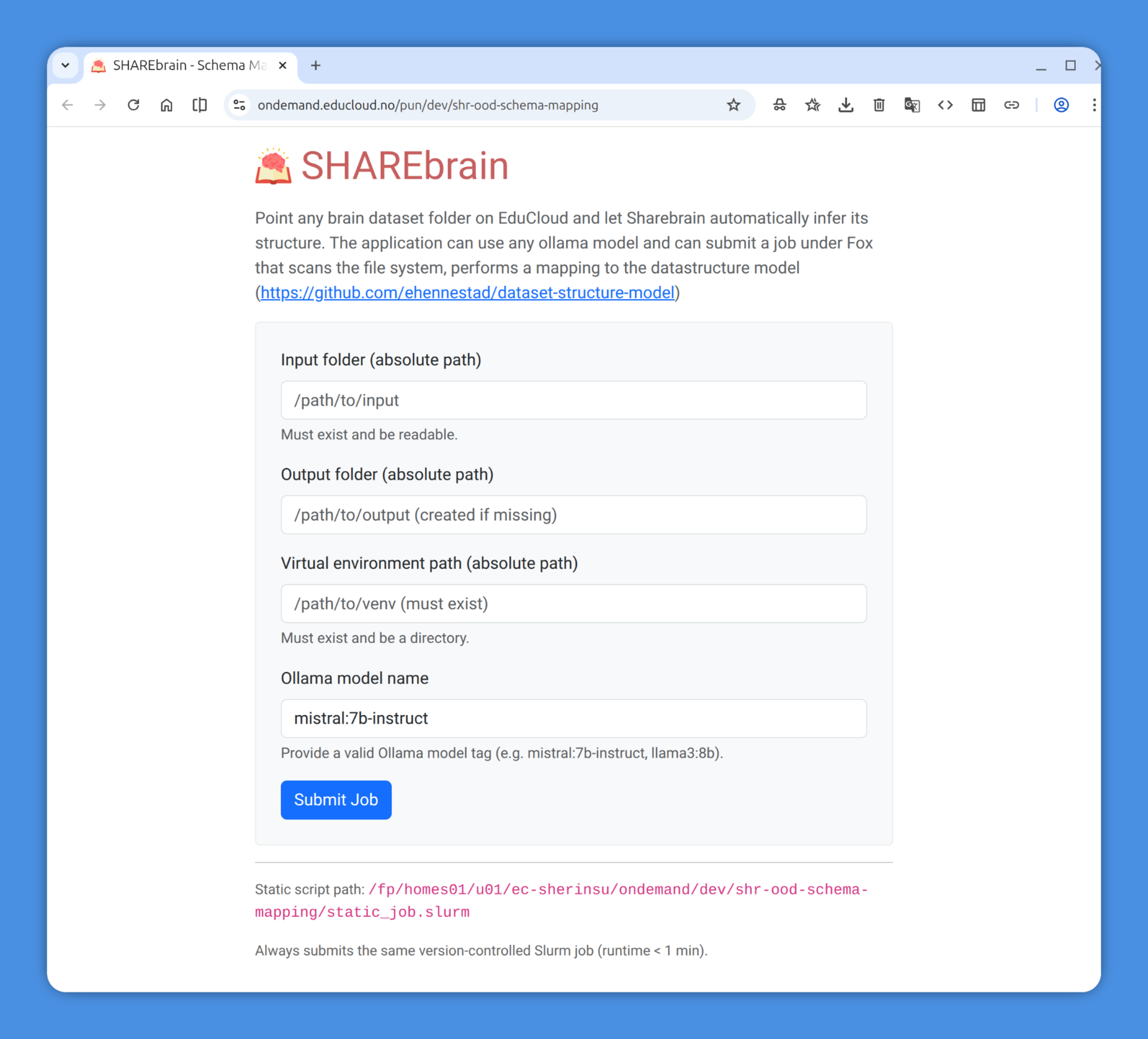
The current web interface is developed using Python Flask and exposes only a limited set of parameters. However, the architecture allows future versions to expose additional settings such as model selection, prompt text, decoding parameters, input dataset selection, and output validation options. This will make it easier for researchers to experiment with different combinations of prompts, models, and parameters to identify the best setup for the SHAREbrain use case.
The maintainers can manage and extend the application through developer access to EduCloud Open OnDemand. This makes the prototype a practical starting point for continued development. Future work should include testing with real datasets from the research team, evaluating the correctness of generated JSON mappings, comparing multiple LLMs, improving prompt design, and adding validation against the Dataset Structure Model.
Overall, the delivered prototype demonstrated that an LLM-assisted dataset structure mapping workflow can be integrated into EduCloud and Fox using a user-friendly web interface. It provides a foundation for building a more complete SHAREbrain system that can reduce the manual overhead of dataset curation and support more reproducible neuroscience data sharing.
All scripts and documentation related to this project are available at the github repo https://github.uio.no/sherinsu/ShareBrain. The GitHub repository can be cloned by any user with Open OnDemand sandbox access enabled, and it can be run as a web application inside EduCloud Open OnDemand. The application source can also be modified directly within the Fox infrastructure, making it easy to adapt or customize the application.