The prizes honour academic staff at UiO for outstanding efforts and achievements. Here are the winners in 2026.
The Research Award

Professor Anne Simonsen receives the Research Award for her ground-breaking work on autophagy; the cells’ own system for clearance and recycling. She explores major questions related to the inner life of cells, such as how cells protect themselves against harmful proteins and how failure in these processes contributes to ageing, cancer, and neurodegenerative diseases. Her research has, among other things, shown that increased autophagy can dramatically extend lifespan, while failure in the process can lead to Parkinson’s-like symptoms. Simonsen is a leading figure in her field and is at the very forefront internationally.
The Education Award
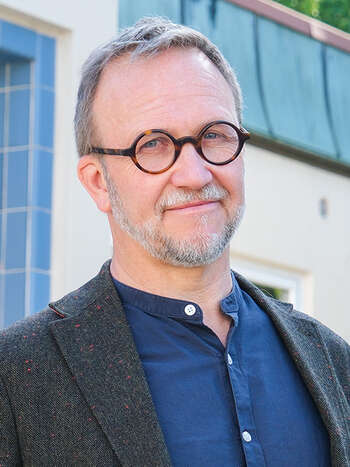
Professor Marius Timmann Mjaaland receives the Education Award for his work on establishing the course “Interdisciplinary Ecology in the Anthropocene”. His vision of thinking more broadly and in a more interdisciplinary way is just as strong today as it was five years ago, when Mjaaland launched his plan for how teaching and education at UiO can be changed if students are to understand the scale of the climate and nature crisis while also engaging more deeply with the issues. The courses have contributed to innovation both pedagogically and academically, through interdisciplinarity, debate, mutual supervision among students, and a “bottom-up engagement” that shapes the seminars.
The Dissemination Award

Professor Are Rachløw and Researcher Anders Kvellestad receive the Dissemination Award for how they, both individually and together, have built up a unique and diverse dissemination practice that makes theoretical physics relevant, understandable, and meaningful for many different groups in society – children as well as adults. In an exemplary and accessible manner, they give people an understanding of deep concepts in physics, thought-provoking philosophical points, and an insight into modern research methods.
They collaborate across disciplines and environments and have used many channels for dissemination: classical lectures, appearances in pubs, theatres, art exhibitions, trains, ferries, barns, churches and at science festivals. They have written scripts for animated films, contributed to feature films and novels, blogged, produced teaching resources, and been guest lecturers for students in both the natural sciences, literature, and philosophy. They have also taken the initiative for a new popular science course at UiO, FYS1050 Physics for the public, with nearly 200 students in its first semester. Their target groups are wide-ranging.
The Innovation Award

Professor Malcolm Langford receives the Innovation Award for his efforts in legal innovation. Langford’s ground-breaking and prize-winning research in law and data science, and his ability to mobilise widely, have contributed to legal reforms in international law and the development of new, secure data infrastructure and AI tools for the public sector. These are outstanding examples of research-based social innovation that have supported, among other things, an extensive UN-led reform process to address criticism of bias in international investment law and that meet concrete needs within the judiciary and public administration.
Award for Young Researchers

Professor Peder Langeland Myhre receives the Award for Young Researchers for his work in cardiology, with specialisation in heart failure. He studies how innovative methods such as biomarkers, AI-based echocardiography, and digital home monitoring can improve diagnosis and treatment of heart patients. His research has provided new insight into how proteomics can identify risk of heart failure, and he has made key contributions to the understanding of cardiac involvement in Covid-19. Myhre became a professor at a young age and leads several major research projects.
About the University Board Awards
The University of Oslo annually acknowledges achievements in research, education, dissemination, and innovation through five awards.
The awards aim to stimulate increased activity and inspire the academic communities at the university. Each winner receives 250,000 NOK and a work of art.