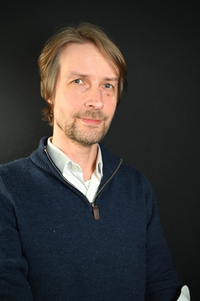
1. How did you become involved in INTED and interdisciplinary education?
I was involved in the Honours Programme, one of the University’s flagship interdisciplinary initiatives, and was invited to join INTED during its application phase. Through my work with the Honours Programme, I had already gained experience working with this particular student group.
I also have an interdisciplinary, or perhaps multidisciplinary, background myself. I completed a degree in Informatics at the Faculty of Mathematics and Natural Sciences and a degree in Clinical Psychology at the Department of Psychology. This allowed me to belong to two quite different academic worlds and communities. When you open yourself up in that way, you become better at communicating and collaborating with people who see the world differently from you. That is both enriching and highly valuable when working across disciplines.
2. You are the course coordinator for HON3000, which is part of the Honours Programme. What makes the course interdisciplinary?
When the Department of Psychology took responsibility for the third year of the Honours Programme, we had to consider what we wanted students to gain from the experience. We worked closely with INTED to clarify the interdisciplinary goals of the course and benefited greatly from INTED’s expertise and experience in interdisciplinary education.
Since the third year is anchored in the Faculty of Social Sciences, we focused on issues that are particularly relevant from that perspective. One such issue is the rise of artificial intelligence. Previously, students worked in groups on specific assignments designed to draw on their diverse competencies. More recently, we have experimented with other pedagogical approaches, including structured debates and problem-oriented learning activities.
As a result, HON3000 has become a forum where students explore how AI affects individuals, society, democracy, and professional practice. Simply placing students from different disciplines in the same room does not automatically make teaching interdisciplinary. There is no integration between disciplines unless students actively work across disciplinary boundaries. Interdisciplinary learning occurs when the collaboration is integrated into both the content and the form of learning.
3. What do you think students gain from participating in interdisciplinary learning environments?
Students who participate in interdisciplinary learning environments gain new perspectives on both their own discipline and those of others. Comparing one's own field with others deepens understanding and often fosters a sense of humility about one's own discipline.
Not every discipline can contribute equally to every problem, but students become exposed to different academic viewpoints and recognize the value of diverse forms of expertise. I believe interdisciplinary learning environments promote greater respect for others while encouraging curiosity and a stronger orientation toward collaboration.
4. What do you see as the potential of interdisciplinary education?
I believe interdisciplinary education is enriching in many ways. Having studied both social sciences and natural sciences, I feel that this breadth has deepened my understanding and shaped the way I see the world. There is always a discussion in higher education about the balance between depth and breadth, but I see interdisciplinarity much like traveling and encountering different cultures. It provides new perspectives and alternative ways of understanding the world.
I also believe that exposure to diverse perspectives changes how we approach problems. Although having such a broad background has occasionally been challenging in my own career, the overall benefits have been substantial. Research on attitudes suggests that people who have been exposed to different academic environments are often more open to the idea that others may hold valid perspectives. This fosters respect, better communication, and a deeper appreciation of how others can contribute in ways that complement one's own expertise. Interdisciplinary environments create opportunities for these encounters and can open the door to new insights.
5. Why is INTED important?
INTED plays an important role by bringing together, supporting, and connecting academic communities across the university. The center contributes tools, institutional knowledge, and pedagogical expertise, and has become a hub for those interested in developing strong interdisciplinary educational initiatives.
We draw on contacts and experiences from around the world to strengthen how we support interdisciplinary education, and we are continuously learning. Many of the developments we have implemented in HON3000 would not have been possible without the support provided by INTED.
6. With interdisciplinarity on the rise, what do you see as the future of higher education?
When we look at the future of higher education, we are in the midst of a transformative development driven by artificial intelligence. AI is influencing both what higher education is and what it should become. AI is inherently interdisciplinary and can draw on knowledge from all disciplines to generate new forms of understanding.
This challenges us to reconsider what is truly worth learning. Skills that were previously considered essential, such as coding, have taken on new meaning in light of AI tools that can perform many of these tasks. It may be that specialization becomes somewhat less important when such support tools are available, but the reality is that no one knows exactly which skills will be most valuable in the future. The pace of change is extraordinarily rapid.
While it is difficult to predict which competencies will matter most, it seems likely that interdisciplinary programmes will become increasingly important, particularly in response to technologies that fundamentally change how we work and engage with knowledge. In my view, this strengthens the need for humanistic and holistic perspectives combined with interdisciplinary competence. The ability to step back, think in terms of principles, systems, and connections, and engage in critical reflection will likely become even more important in the years ahead.