From POL.SCI in Brussels to PECOS in Oslo
For Simone Sessolo, political science was a natural choice after high school.
– I studied languages and literature in high school in Italy, but political science was something I always had an interest for. I really wanted to go abroad for my university studies, so after high school I moved to Brussels to complete a bachelor’s degree in political science.
Although he enjoyed the programme, the broad degree left him unsure about which direction to take next.
– There was not really a specialisation in my bachelor’s, so when I graduated, I did not know exactly what I wanted to do for a master’s degree.
Instead of choosing immediately, Simone applied for several internships. He eventually ended up in Geneva, working with communications at the Geneva Environment Network, an organisation that convenes events and actors working on environmental issues.
– During that internship, I discovered the field of environment, peace and security. That made me start looking for master’s programmes that included those kinds of topics.
Finding the right master’s programme in Oslo
When searching for programmes, Simone came across the University of Oslo and the master’s programme in Peace and Conflict Studies, commonly known as PECOS.
– UiO was very well ranked, and I thought it would be exciting to live in Oslo. Then I saw that PECOS was internationally recognised and seemed very open in terms of what type of courses you could bring into the programme, and that was really appealing to me.
Both trying somewhere new to live, and the flexibility in PECOS was in other words important to him in choosing.
– You could start with peace and conflict as the overarching field and then connect it to your specific interest - for me, environmental issues. I was very happy when I got accepted!
He began the programme in 2020, at the height of the COVID-19 pandemic. Like many international students at the time, his introduction to the programme and to Norway was quite unusual.
– My first semester was entirely online. I was still living at my parents’ home in warm Italy, and I met my fellow students only online. Then, in January 2021, I arrived in Oslo. It was cold, dark and there was snow everywhere. It was quite a shock at first!
Although he was not used to snow and ice, he quickly grew fond of the Norwegian winter.
– Everything was white and soft, and really beautiful. I always liked the snow in Oslo, he smiles.
Lasting friendship and (long awaited) summer in Oslo
The PECOS cohort that Simone was a part of included both Norwegian and international students. The programme’s relatively small size made it easy to get to know fellow students, even under the restrictions of the pandemic.
– We got to interact a lot and discover Norwegian traditions and culture. At some point during COVID19, the only public place that was open was the study room. It really helped break the isolation and the monotony of the same four walls of my student accommodation.
Simone looks back on his time in Oslo with warm memories, particularly of the contrast between the city in winter and summer.
– Oslo feels like a completely different city in the summer. I have so many good memories of going to parks, hiking in the Marks, swimming in the fjord, in the lakes, in the river with my PECOS friends.
He still keeps in touch with several people from the programme.
– It is more difficult when you do not live in the same city anymore, but we still call each other and stay in contact.
A fine balance: Freedom and support in the master’s thesis
One of Simone’s strongest academic memories from PECOS is writing his master’s thesis. He appreciated both the independence of the process and the guidance he received from his supervisors, Scott Gates and Jonas Vestby. Gates was his professor at UiO, while Vestby works at the Peace Research Institute Oslo (PRIO).
– There was a lot of freedom and autonomy. You could organise your work in the way that suited you; if you wanted to do intensive research for a full week, you could do that. If you felt you needed a bit of time away from it, that was also possible.
The two supervisors had different perspectives and approaches, which Simone found valuable.
– They were both extremely helpful whenever I had questions. We met about once a month, and their comments were always useful. But they never micromanaged me. I really felt that I was the project leader, while they were there to give advice and help me move forward.
His thesis “Less oil revenues, more democracy?: An analysis of the effects of negative oil price shocks on democratization ” investigated how negative oil price shocks affect democratisation. The starting point was a theory that authoritarian leaders can use oil revenues to maintain elite loyalty. If the price of oil falls, the theory suggests, leaders may have fewer resources available to maintain support – potentially opening a window for democratisation.
The data, however, did not show the expected effect.
– I remember panicking a little when I found no effect. You read so many articles where the authors find exactly what they expected to find, and suddenly you think: What do I do now?
Rather than seeing the null result as a failure, he used it as a starting point for further discussion.
– Maybe negative oil shocks do not lead to democratisation, but to another form of regime change. Perhaps elites replace one leader with another while keeping the same system in place. Or perhaps leaders find other ways to maintain their support. A null result is still a finding.
Opportunites via UiO
As part of the PECOS programme, Simone had an internship at PRIO. The internship was in the communications department, and the position built on his earlier communications experience from Geneva.
– My previous communications experience probably helped me get that internship at PRIO. It also connects to what I do in my current job. Communications is a field I enjoy because it allows you to work with many different themes and domains.
The internship also gave him the opportunity to get to know PRIO before the actual thesis-writing process began the semester after.
– Because of the pandemic, much of the internship was still online. But it gave me valuable insight into the work at PRIO and helped me build connections in the field.
During the second year of his master, Simone started as a research assistant at the Center for Research on Extremism – C-REX at UiO.
- I started at C-REX during the second year of my master’s. I initially worked only on the Right-Wing Terrorism and Violence (RTV) Dataset. Then, I also worked on other projects at C-REX.
After graduating in 2022, Simone stayed in Oslo for another year and continued at C-REX.
- Political violence and terrorism weren’t a field I expected to work in, but I have to say that I found it very interesting, which then motivated me to stay longer. I met some incredible people whose work I found really meaningful.
Bringing cities into international negotiations
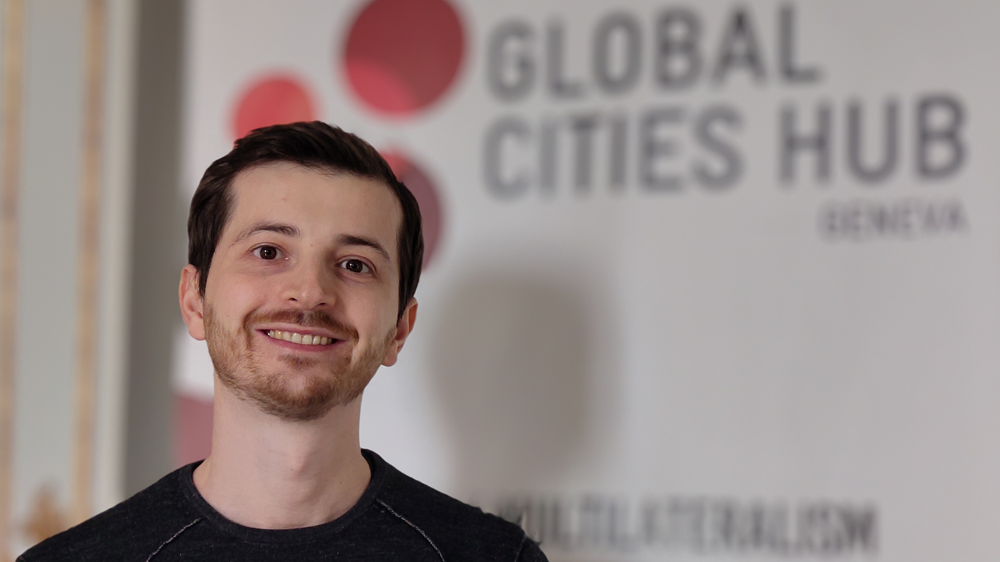
After that year Simone moved back to Geneva, where he now works as an Events and Communications Coordinator at the Global Cities Hub.
The organisation works to strengthen the role of local and regional governments in international governance and to ensure that urban issues are promoted on the multilateral agenda.
– International agreements can seem very abstract, but they have to be implemented on the ground in order to have an effect. And the actors implementing them are often local and regional governments.
The Global Cities Hub works with mayors, city administrations and regional authorities, including Oslo in some cases. Its aim is to ensure that these actors are not merely implementers of international agreements negotiated by states but are included in international discussions from the start.
– Local and regional governments know what makes international agreements effective and possible to implement. Their role should not just be to receive instructions and try to implement them with uncertain funding.
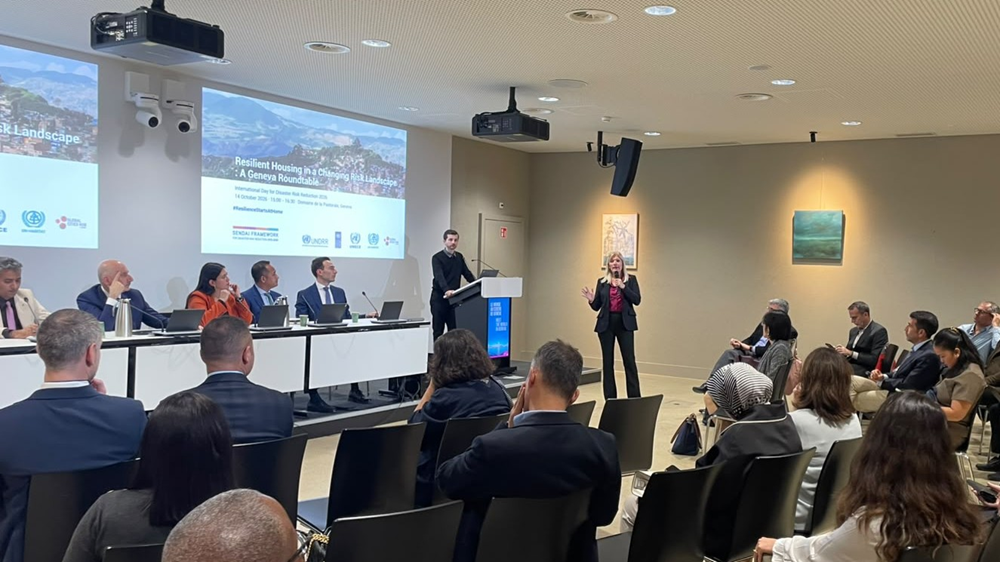
A key part of the organisation’s work is the annual UN Forum of Mayors in Geneva. The Forum brings mayors from around the world together to develop recommendations on a chosen theme. These recommendations are later submitted to the UN Economic and Social Council, ECOSOC, and the UN General Assembly.
– Every year has a different theme. The idea is to bring local and regional perspectives into global discussions and make international policymaking more connected to what happens in cities.
Events, communication and policy work
At the Global Cities Hub, Simone works in a small team of four people. The organisation’s portfolio includes issues such as climate and environment, human rights, smart cities, inclusive multilateralism and urban health.
– My role includes events and communication, so I support the team with events and manage communication and social media. But I also work directly with our member cities and regions, making sure they know what is happening and can engage in the opportunities available. This can include helping local and regional representatives participate in international negotiations, either through their national governments or through the organisation’s own role as a non-governmental organisation, he says.
Simone also contributes to the organisation’s more “academic” tasks.
– Because we are such a small team, you get to work across many themes and take on a broad range of tasks. I increasingly contribute to our advocacy in the different policy fields we work in.
Although the work is not directly centred on peace and conflict, he sees clear connections to his education.
– Most “peace and conflict” issues are primarily handled by national governments, think about disarmament for instance. But human rights, climate and sustainability, digitalization and health are areas where cities and regions have a great deal to contribute. If states want to reach the goals they set for themselves, they need cities to be on board.
Working in a growing field
Simone describes the work of including local and regional governments in global governance as an emerging and innovative field.
– It is a relatively new way of thinking about multilateralism. There’s a lot of room for creativity in finding ways to include cities and regions in the international system.
At the same time, that innovation can create challenges.
– The most challenging part is that more inclusive multilateralism can be seen as redistributing power away from member states. Some states are very receptive to including local and regional governments, while others are more reluctant.
Working in a small organisation has also given him opportunities to meet people he would not otherwise have encountered so early in his career.
– My colleagues have many years of experience from diplomacy and foreign ministries. Through the work, I get to meet high-level people from international organisations. On a personal level, it is incredible that people I never ever dreamed of even meeting, know me by name.
Skills that travel across sectors
Simone highlights the broad and transferable skills gained through PECOS as especially valuable in his career.
– Of course, the programme gives you substantive knowledge about peace and conflict theories. But it also provides cross-disciplinary skills that are useful in many different jobs.
– I would say research skills and data analysis are particularly relevant; you really learn how to conduct research. That is useful whether you remain strictly within peace and conflict studies or move into another field, such as communication, policy work or data analysis.
He also points to the programme’s strong emphasis on methods.
– PECOS and political science at UiO are known for being method-heavy. Employers value that. You do not only use methods in your thesis; you use them when you research a topic, prepare background material or contribute to a larger investigation.
For students hoping to pursue a similar career, Simone has two main pieces of advice.
– The first is to build a network! Everyone told me that networking was important, and I knew I was not very good at it. Still, I underestimated how important it really is.
He experienced the difference between building a career in Oslo, where he had contacts through UiO and PRIO, and moving to Geneva with a much smaller network.
– When I moved to Geneva, I knew very few people, and that made finding a job much more difficult. In Oslo, opportunities and networks were built more naturally through the programme, internships and work experience.
The second piece of advice is to take the methodological and transferable skills seriously.
– Become good at research and data analysis. If you are less interested in quantitative methods, become very good at interviewing or qualitative analysis. Learn to use tools such as R or qualitative research software.
These are skills that can open doors well beyond a narrowly defined field of study.
– They are useful whether you want to become a researcher, work in communications, analyse data or stay in peace and conflict studies. Those broad skills will help you in many different job searches.
Tips from Simone:
1. Build your network, even if it feels uncomfortable. Opportunities often emerge through the people you meet during your studies, internships and work experiences.
2. Use internships to explore possible career paths. Internships can help you gain experience, develop practical skills and discover which kinds of work you enjoy.
3. Invest in transferable methodological skills. Research, data analysis, interviewing and the ability to work with different types of evidence are useful in a wide range of jobs.
Simone Sessolo
Study program: Master i Peace and conflict studies
Graduated: 2022
Job title: Events and Communications Coordinator
Employer: Global Cities Hub, Geneva