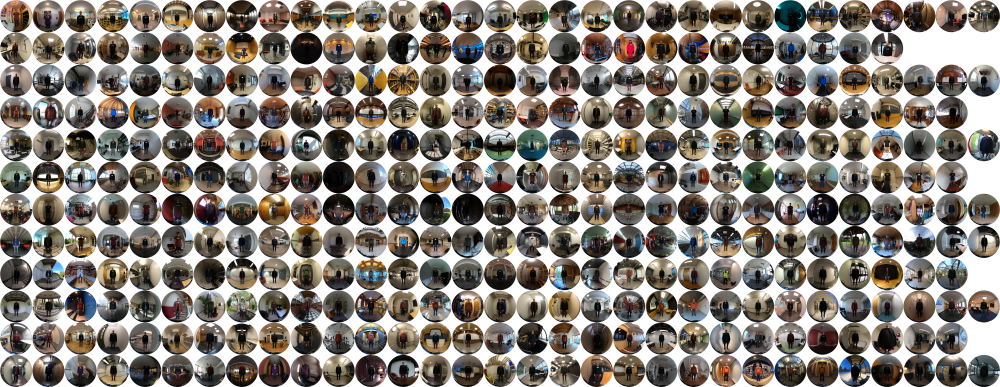
Project Overview
The project started on 1 January 2023 and was completed on 31 December 2023, resulting in 365 recordings—one per day. Each recording consists of a structured standstill session lasting approximately 10 minutes, typically conducted around midday. In practice, each session required additional time for preparation, setup, and data handling, making the project a sustained daily research activity over the entire year.
The overarching goal was to generate a longitudinal dataset of bodily micromovements and environmental characteristics to support research on rhythm, perception, and spatial experience in everyday settings. The dataset complements existing motion capture collections in the Oslo Standstill Database and contributes to ongoing research in the MICRO and AMBIENT projects.
Data Collection
All recordings were made using portable, synchronised technologies, enabling data capture across diverse real-world environments. Each session includes:
- Motion sensor data from a smartphone mounted on the body
- Heart rate (pulse) data from a wearable device
- 360° video recordings of the environment
- Ambisonic audio recordings capturing spatial sound
Sessions were synchronised using an initial and final clap, allowing alignment across modalities and enabling acoustic analysis of the room. Immediately after each recording, notes were written to document subjective experience.
Longitudinal Design
A key principle of the project was to record each session in a new indoor environment. This design introduces variation in spatial, acoustic, and visual conditions, while maintaining a consistent bodily task (standing still). Over time, the dataset captures both environmental diversity and subtle variations in human micromotion in everyday contexts.
Maintaining a daily recording routine required careful planning and flexibility, especially in balancing work schedules, travel, and access to suitable locations. Finding new recording spaces became increasingly challenging as the project progressed, highlighting the practical constraints of longitudinal fieldwork.
Research Context
The dataset is closely linked to research on human micromotion and embodied cognition, and serves as empirical material for two main research trajectories:
- The ongoing work on human micromotion, which has been conducted in the Sverm and MICRO projects
- The AMBIENT project, investigating responses to audiovisual and spatiotemporal characteristics of indoor environments
Beyond its scientific value, the project also demonstrates how small, consistent daily actions can accumulate into substantial research material. Over the course of the year, the recordings amount to hundreds of hours of structured observation and data collection embedded in everyday life.
Data Availability
The intention is to make as much of the dataset as possible openly available, while respecting privacy considerations related to recorded environments and incidental presence of people. Derived features, processed data, and analytical outputs are prioritised for sharing to support reuse in research and artistic applications.