Tidligere arrangementer - Side 5

Lecture by Professor Heleen de Coninck, Department of Industrial Engineering and Innovation Sciences, Eindhoven University of Technology.

The Philosophical Seminar With Ram Neta
A primitive element of a Galois field F is a generator of the group of units F*. Finding such elements is entirely non-trivial and this search has given rise to many interesting results in number theory. If one is willing to assume the generalised Riemann hypothesis, then every (non-silly) integer is primitive to infinitely many prime order fields. Moreover, the least primitive element in such fields is less than the square root of the order. I will present an effective method for finding primitive elements in Galois fields with prime-power order. This method is an amalgamation of my hybrid bound on prime divisors and joint work with J. Punch on prime sieves. I will also discuss some of my recent work on least primitive elements.

QOMBINE seminar by Markus Grassl (International Centre for Theory of Quantum Technologies, University Gdansk)
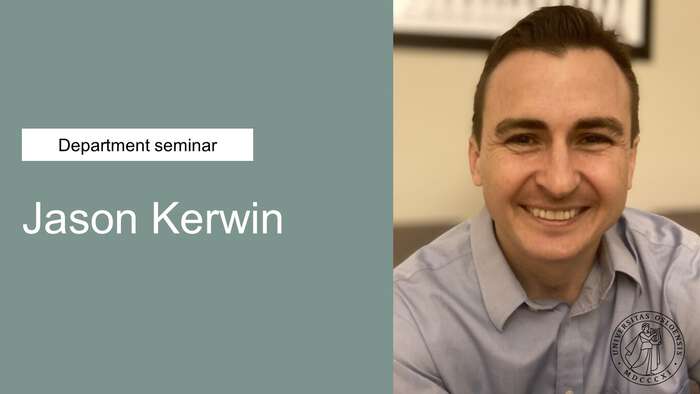
Department seminar. Jason Kerwin is an Associate Professor in the Department of Economics and a Brimmer Distinguished Scholar at the University of Washington. He will present the paper: How to Build a Reader: Evidence from a Scalable Literacy Intervention in Ghana

In this talk, Elin McCready (ICREA/UAB) presents a novel approach to the meaning of slurs in three parts: a descriptive predication, an indexical social meaning, and an invocational component, which together account for a broad range of facts about slur meanings.

The Departmental Seminar Series features Frida Hastrup, Director of the Centre for Sustainable Futures at the Saxo Institute, University of Copenhagen.

Brad Jordan (IFIKK, UiO)
PDE seminar by Konstantina Trivisa (University of Maryland)
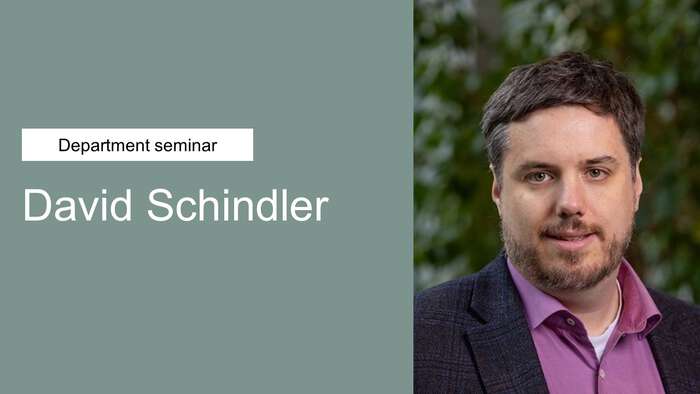
Department seminar. David Schindler is an Associate Professor in the Economics department at Tilburg University. He will present the paper "Contagious Prejudice: The Marocchinate".

A talk by Seongjin Jeong, Distinguished Research Professor in the Department of Economics at Gyeongsang National University.
Jan Skotheim is Professor of Biology at Stanford University and Professor, by courtesy, of Chemical and Systems Biology. His research focuses on understanding how cells grow and how cell growth triggers cell division, a fundamental process with important implications for normal physiology and diseases such as cancer.
Skotheim leads an interdisciplinary research program that combines mathematics, physics, engineering, biochemistry, genetics, and cell and systems biology. His laboratory primarily studies cell-size control and the cell cycle using budding yeast as a model organism, with the goal of uncovering the molecular mechanisms that connect cellular growth to division.
He did his PhD in Applied Mathematics from the University of Cambridge in 2004. He subsequently conducted postdoctoral research in genetics, cell biology, and systems biology at The Rockefeller University before joining Stanford’s faculty.

José Ricardo Correia, Institute of Theoretical Astrophysics, University of Oslo.
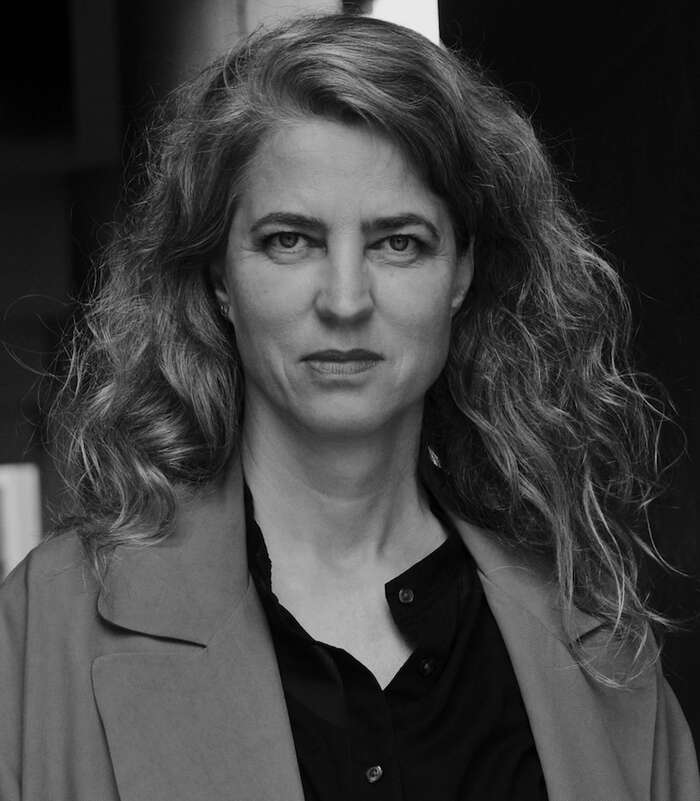
In this lecture, Juliane Rebentisch (Hochscule für bildende Künste Hamburg / Princeton University) will discuss imaginaries of the future in a time of ecological crisis.

The African Anthropology seminar series features Professor Lorenzo D'Angelo from La Sapienza University, Rome
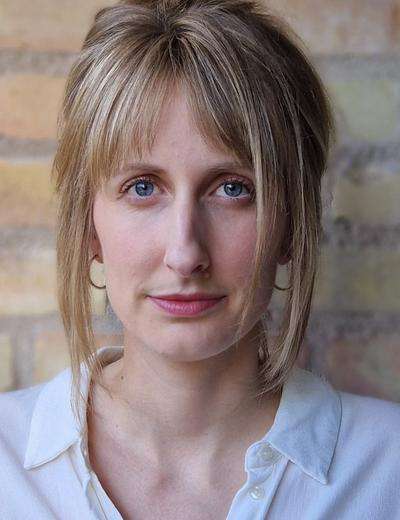
Mia Quirin, Göteborg universitet, kommer torsdag 10. september og presenterer sin avhandling, P SOM I POETIK. Poeter om poesi i svenska litteraturtidskrifter 1950-2019.
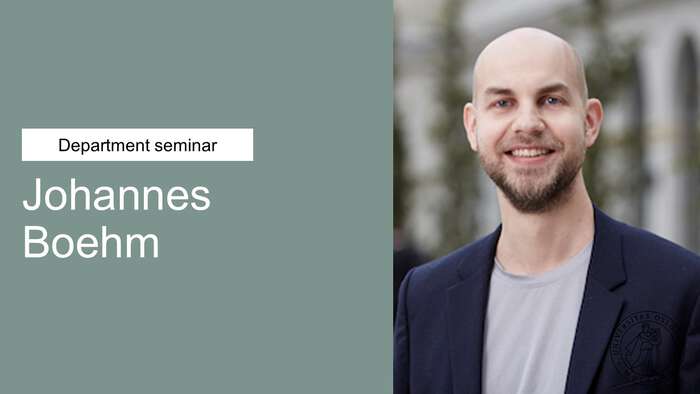
Department seminar. Johannes Boehm is a Professor of International Economics University of Geneva. He will present the paper "Trade and the Origins of the Territorial State".
By Frode Strisland, Senior scientist at the Health Department at SINTEF Digital. Associate Prof II at the Electronics group at Physics

The Departmental Seminar Series features Sae Nakamura, Associate Professor in the Department of Cultural Anthropology at The University of Tokyo
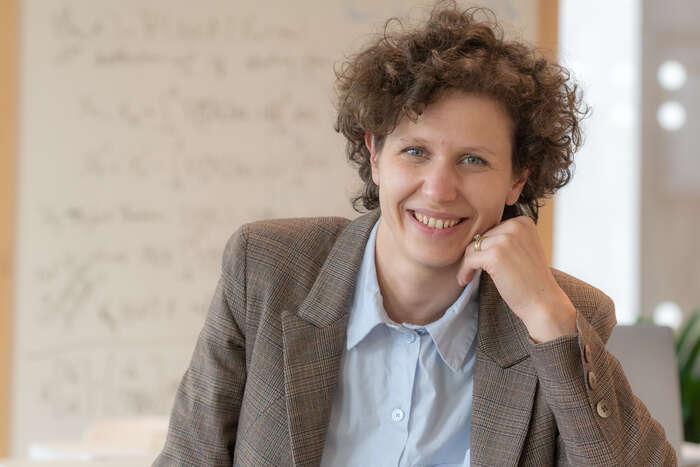
Alice Corbella is an Assistant Professor in Applied Statistics at the University of Warwick. Her research centres on Markov chain Monte Carlo (MCMC) methods, with a particular focus on Zig-Zag sampling and its application to Bayesian inference of infectious disease dynamics from epidemic data.
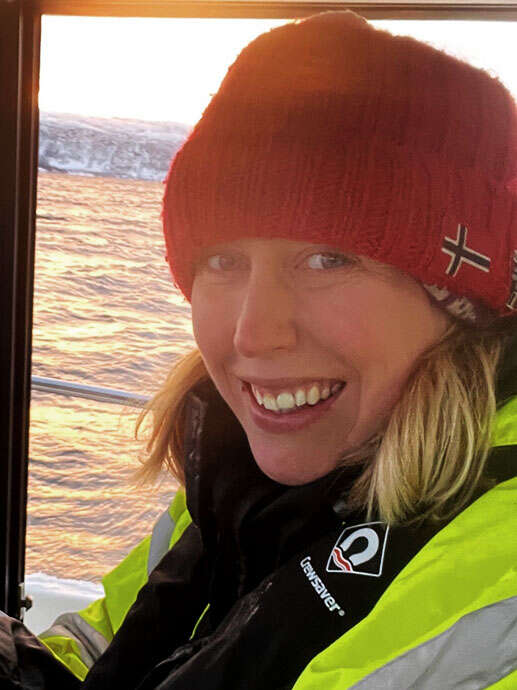
PhD candidate Clare Margaret Andvik at the Department of Biosciences, Faculty of Mathematics and Natural Sciences, is defending the thesis 'Multiple stressors in Norwegian killer whales: Integrating the effect of chemical pollution with other anthropogenic stressors' for the degree of PhD.
By Elisa Bonaccorso and Juan Manuel Guayasamin from Universidad San Francisco de Quito