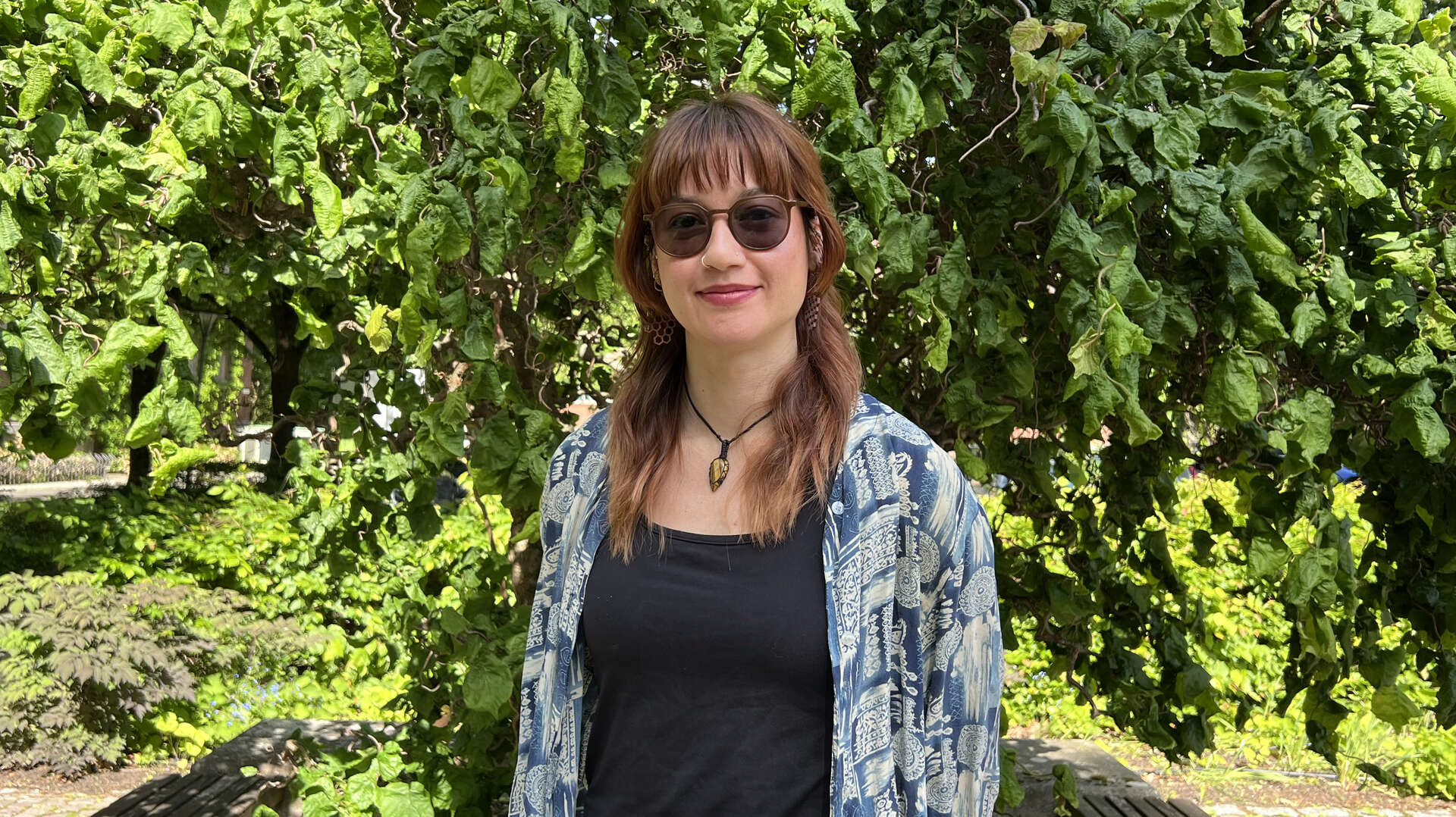
Clare Wadsworth from San Francisco traded molecular biology for classrooms in Hawai’i. They are now pursuing an international Master’s in Research in Special Needs Education, with a focus on research-informed, inclusive pedagogy.
Scientist Turned Teacher
– I originally wanted to be a scientist and work in a lab. My undergraduate degree is in biological sciences with a concentration in molecular biology and a minor in chemistry.
But with some lab experience, Clare realised this was the wrong trajectory for them. From there, they got a position at a school in Hawai’i.
– I am passionate about facilitating spaces for learning, so I see myself as a facilitator more than a teacher; I love the relationships I made with the kids through this process, says Clare.
Love for progressive pedagogy
Clare is passionate about practicing progressive pedagogy.
– I felt it was important to be mindful of the post-colonial context in Hawai’i, where I was teaching a majority of indigenous Hawaiian students. In many ways there is a conflict between the state system, western education, and indigenous values or practices and so I was always striving to decolonize the science education.
But the budget and the time schedule do not always allow for inventive teaching and experiential learning.
– I had freedom to try new things and take the kids on engaging field trips, but when striving for inclusion and progressive education, practically speaking, it was very constraining at times and required a lot of work after school hours, says Clare
– I put in way more time than I was paid for. This is unfortunately all too common for teachers these days.
Research in Special Needs Education
Circumstance led Clare to Oslo and the master’s programme Research in Special Needs Education (RSNE). This programme focuses on inclusion and diversity in education, while giving the students a solid introduction to research methodology.
– I have the quantitative background from my undergrad but lacked qualitative methodology courses. I was so lost in what qualitative research was, so I felt that this programme could make me a more well-rounded researcher, Clare reflects.
– This programme is also for people who want to advocate for inclusive interventions and use research-based evidence in a way that can support their advocacy, according to Clare.
Clare describes an inspiring lecture they had about the concept of inclusion itself and the evolution of practice of it.
– I've noticed in my teaching experience that we can say something is inclusive or even market it as inclusive, but when we assess it and reevaluate how to make it more inclusive, sometimes they're not actually aligned.
Find your interest
Clare explains that the first year introduces the students to a wide variety of topics related to special education that they are likely to encounter in an educational setting, giving them a chance to find their unique interests.
– It aims to balance a broad range of topics in special needs education, while going into a reasonable level of depth.
– Even though my interest is in reading and neurodevelopmental disorders, specifically ADHD and autism, I appreciate how I could also learn about, for example, the intellectual disabilities, Augmentative and Alternative Communication (AAC), and math difficulties.
There is also a Norwegian master’s programme on Special Needs Education (master i spesialpedagogikk) at the University of Oslo. Clare reflects on the difference between the two:
– If you can speak Norwegian and are interested in working in the classroom or in settings such as BUP (Barne- og ungdomspsykiatrisk poliklinikk), spesialpedagogikk may be the better choice.
– However, if you are interested in working with the research that informs the applied fields and maybe working internationally in academia, then I feel like this programme prepares you well for that, reflects Clare.
Researching reading
Clare’s master’s dissertation examines the educational self and its relationship to reading. They are especially interested in neurodivergent students and how these students negotiate moments of tension and ambivalence related to their reading experience.
– I'm curious about how students form their educational sense of self and how reading is connected to this. This is a more dynamic, temporally unfolding, and context specific approach than what the concept of reader self-concept offers. It requires a qualitative approach, according to Clare.
Advice for students
– Radically include yourself to form study groups. You can say “Hey I appreciate your thoughts. I’m looking to form a study group. Would you be interested?”, suggests Clare.
– I would also encourage practicing tenacity, pushing through something boring or difficult. Especially for those of us who intend to work with kids, I feel like it is our responsibility to learn well, so that we can be competent professionals, says Clare.
– If you know that you're going to work with students, you may not find certain courses relevant, but what you might gain out of it is what it feels like to be a student in a class you're not engaged in.
Clare points out that RSNE students have the opportunity to have the same experience that their own students are feeling. But points out that the students are at an age where their life trajectory can shift based on the adults in their life.
– You can be one of those adults who can resonate with them. I would encourage that you put yourself through it as an experiment and try things outside of your comfort zone, whether that is asking a question in lecture, forming a study group with a stranger, or doing a presentation in English if it is not your first language.
– Come curious, practice curiosity.