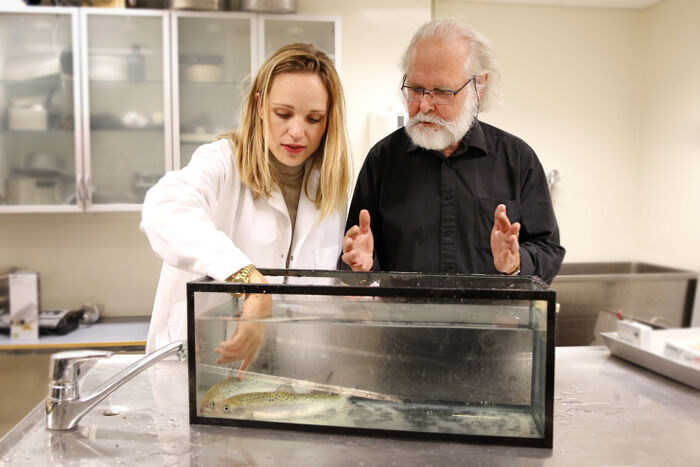
What happens to a stock of fish if we overexploit it? When do we need to stop fishing to save a stock from collapse? The CEES at UiO is engaged in cooperation with Nordic, European, Russian and American scientists to find answers to such questions.
News - Page 9
The Clinical Effectiveness Research Group at UiO is engaged in close collaboration with top researchers at Harvard University to find out what is effective and ineffective in the prevention of colorectal cancer. They undertake studies that few others are able to emulate.
A new and simpler surgical method for the treatment of intestinal perforation is a poorer alternative for patients compared to the old method, researchers at the University of Oslo and Akershus University Hospital find. The study raises important questions about the testing of new surgical methods.
Increasing numbers of younger people are being admitted to hospital with heart attacks. Researchers are now hoping that more people will change their lifestyle if they know their own heart age.
The University of Oslo is conducting a number of life-science projects that share the same goal: to address the increasing problem of antibiotic resistance, considered by the World Health Organization (WHO) to be one of the greatest health threats the world is facing. Interdisciplinary collaboration is required to solve this huge challenge to societies worldwide.
There is a great need for new anti-microbial drugs, because a number of bacteria are now resistant to those antibiotics that are available on the market. Results produced by researchers at the University of Oslo using so-called zinc chelators are so promising that the Research Council of Norway and a commercial stakeholder have decided to grant several million NOK in support to the project.
In spite of many years with national scientific guidelines for the use of antibiotics, the problems caused by antibiotic resistance are increasing in Norway too. Digital management of the prescribing practices of doctors is needed to diminish the use of antibiotics in hospitals as well as in general practice, according to Dag Berild, Senior Consultant.
Diagnosis of coeliac disease requires a tissue sample from the small intestine, which can be extremely unpleasant. Researchers at the Faculty of Medicine have developed a blood test which provides a rapid, painless answer.
The foundation of good health is laid early in life. Two studies show that dietary habits and body size in Norwegian children remain stable for the first seven years of life.
For some researchers, good and balanced dissemination of research is particularly important, as the results they convey can have major consequences for others. This is the case for researchers at the University of Oslo who are investigating how the use of medicines during pregnancy can affect the development of the foetus. Interdisciplinary cooperation will take their research a step further.
Researchers at UiO have tested a new device for delivering hormone treatments for mental illness through the nose. This method was found to deliver medicine to the brain with few side effects.
At the University of Oslo we are investing in life sciences in order to gain new insight and to address societal challenges related to health and the environment. A new board has begun coordination of the work in this priority area.
Studies show the success of the first effective vaccine against Ebola. This means that the outbreak in Guinea can be brought to an end in a couple of months.
Professor Ludvig M. Sollid and his research group found the real cause of coeliac disease. They have now been singled out as one of five world-leading research teams at UiO, and will receive substantial funding for their international work.
Scientists have developed a method for synthesizing liver cells at a fraction of today’s cost.
Nerve fibres, which transmit impulses from neurons, play a key role in the nervous system. Until now, no-one knew how they formed.
Researchers have discovered several new gene variants that influence brain volume. We are yet another step closer to finding the causes of a number of psychological disorders.
Researchers have discovered that patients with type 1 diabetes can regain the ability to produce insulin. They showed that insulin-producing cells can recover outside the body.
We all have a gene than can cause lethal blood clots, but also protect us against cell death during a stroke. This raises a dilemma for scientists.
Pain and chronic fatigue frequently go hand in hand. In such cases it does not help to ask patients to put on their training shoes and start exercising, according to recent research on Sjögren’s syndrome.
Cheeses like the Norwegian “gammelost” and Roquefort may prevent weakening of bones when you are ill. New findings show that vitamin K2 protects the production of bone tissue during inflammations.