This text has been translated from Norwegian with the assistance of GPT UiO.
– What is occupying you right now?
– I have been leading the Clinical Division since January 2024. The division consists of highly skilled and committed professionals and is characterised by a wide range of theoretical and methodological perspectives – something I see as a clear strength, both academically and in terms of research. At the same time, I am concerned with developing a good working environment, a collaborative and collegial culture, and effective systems that support both research and teaching.
– The division plays a central role in teaching on the professional psychology programme, where we work closely to connect research, clinical practice and education.
– There are a number of exciting and clinically relevant projects under way in our environment. An important focus area at the moment is DRIVE – an interdisciplinary network across divisions and theoretical and methodological orientations, aimed at increasing our understanding of depression and developing more effective treatment methods.
– I am also concerned with how we can reach broadly with evidence-based, low-threshold interventions that can prevent mental health difficulties in children and young people from developing into more serious disorders. I mainly work with anxiety and depression, and with how we can use technology and the school setting to reach more children at an early stage, while ensuring that the interventions are effective and experienced as safe and relevant by those who take part.
– Right now, I am working on several closely related projects. In ADD-ME, we are further developing a hybrid version of the “Mestrende barn” intervention, where we combine in-person sessions with more engaging digital solutions, developed in collaboration with young people themselves and with Mental Helse Ungdom.
– In parallel, I am developing a digital parenting guide, “Trygge foreldre – Modige barn”, a digital and flexible guidance programme that will offer tailored and easily accessible support in several languages to parents who are worried about their child’s mental health. The aim is to strengthen parents’ ability to help their children early on, while also easing the pressure on services. Here we have a good collaboration with Voksne for Barn in connection with user testing.
– In addition, I am working on the Coping@School project in collaboration with the City of Oslo, where we are examining how school-based, low-threshold interventions can contribute to better school attendance and reduce anxiety and sadness among children who are beginning to struggle.
– I am very interested in whether these interventions work and how the children themselves experience them. In an article I recently submitted, we look at children’s experiences of stigma, satisfaction and coping in preventive school-based interventions. This is important to me, because interventions must not only be effective; they must also be experienced as safe and relevant by those they are designed for.
– What all these projects have in common is a desire to develop interventions that are effective, accessible and feasible in everyday practice.
– If you had to explain to an eight-year-old what you do at work, in three short sentences, what would you say?
– I work on helping children who feel scared or sad. I create activities for school, online and for parents that can make it a bit easier to feel well. Finally, I try to find out what actually helps, and I care a lot about what the children themselves think.
– What motivates you in your job?
– What motivates me most is being able to help develop new solutions that can make a real difference for children and young people. I am also greatly inspired by collaborating with skilled colleagues and by environments where we share knowledge and learn from one another.
– If you were to do something completely different, what would it be?
– I actually started medical school in Bergen, so I have probably always been drawn to working in health. I think I would have enjoyed being a doctor as well.
– What do you do to switch off?
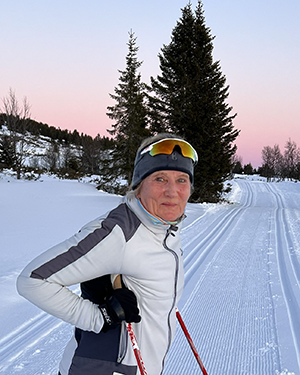
– I switch off best when I’m outdoors and active, preferably together with family or friends – skiing in winter, hiking or cycling during the rest of the year, and I swim outside all year round.