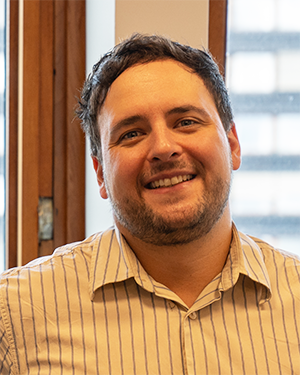
– Which research project are you most preoccupied with?
– I am just getting started with my new ERC project, “Governing elites since the dawn of modern democracy”. One of our aims is to create a database of government members from 1789 onwards. It feels like an almost insurmountable task: we have to document over 230 years of global political history. Fortunately, I have an exceptionally skilled team, so I am sure we will get there. Right now, we are locating sources online and digging up history books from archives, which we then digitise and convert into large datasets with the help of AI.
– What do you want to find out?
– The new dataset can give us many novel insights into political history. One thing I am particularly interested in examining is the extent to which democratisation changes the composition of the political elite.
– My hunch is that even though the political system formally changes, it is often the same people – or the same types of people – who remain in power. For example, A. W. Moltke – Denmark’s first prime minister after the March Revolution in 1848 – was very much part of the king’s inner political circle before the revolution. Moltke came from a noble family, was the son of a former prime minister, and had almost 20 years of ministerial experience under the king. So, we see democratisation, but without power actually being shared with the people.
– Why is this important?
–– We live in a world where democracy is under pressure. This is partly because many people are losing faith that democracy can deliver the change they hope for.
– I recently travelled to Gambia, where the dictator Yahya Jammeh some years ago was forced to hand over power to a democratically elected president. There I spoke with local people about how this had changed the country. One of them replied that it was good that the dictator was gone and that the regime was no longer as repressive, but that it essentially still was the same elite who held power. He did not feel that democratisation had made any real difference to his everyday life.
– It is important to understand when, and under what conditions, democratisation delivers real change and genuine power-sharing. I hope this project can contribute to that.
– Who do you collaborate with?
– I’ve just hired four new colleagues on my ERC project. Moreover, we collaborate with other colleagues at UiO, in the United Kingdom and in the United States. We are also trying to build a community around researching political elites by organising an annual conference at the University of Oslo. Research on political elites has been very fragmented: in political science, people tend to study elites either in democracies or in autocracies, but not both. I believe there is a great deal to learn by sharing knowledge across different parts of political science and from related disciplines such as economics and sociology.
– What do you look for when choosing collaborators?
– I don’t have a particular strategy. Sometimes specific skills are required to solve a task. In this project, we especially need people with expertise in large language models and historical data collection. For me, the most important thing is that we can produce something that is greater than the sum of our individual contributions. And that we have a good time working together.
– Who is your research relevant for outside academia, and what do you do to ensure they benefit from it?
– I think many of our findings will be interesting for people who are curious about political history – also outside academia. To make the data easily accessible, we are building interactive visualisations that make it easy for users to explore the data on their own. We also hope that our research will be relevant for organisations working to strengthen democratic institutions.
– Do you have any examples of your research being used outside academia?
– Many people in Norway will probably remember a series of articles about Norwegian ministers having the lowest level of education in the world. That knowledge comes from two earlier projects – Paths to Power and WhoGov – which my ERC project builds on. The data have also been used in analyses by a wide range of organisations, such as the World Bank, UNESCO and Oxfam.
– Which other research projects are you involved in?
– I originally came to Oslo to work as a postdoctoral fellow on Carl Henrik Knutsen’s ELDAR project, where we studied politics in dictatorships. We are now in the process of wrapping up that project, but many of the findings from this project, will influence my new project. Carl Henrik is also associated with my project. It nicely illustrates how research is a cumulative process, where each new project builds on previous ones.
– What do you find most interesting about being a researcher?
– Before I became a researcher, I worked as a management consultant. There, it was other people who asked the questions, and there was often a set recipe for how we should answer them. As a researcher, I can ask my own questions, and I can think creatively about how they should be addressed. That is a great privilege.