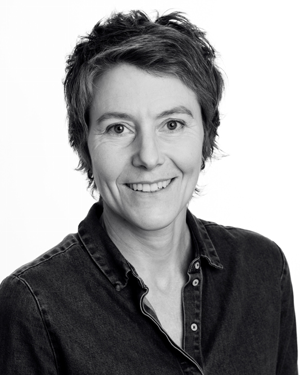
– Which teaching programme would you like to highlight for your colleagues at the faculty right now?
– Psychology is a discipline that spans everything from hard-core natural science to social science and the humanities. It encompasses basic research, applied research, theory, practical skills, the ability to reflect on oneself in encounters with others, as well as an understanding of typical development and the development of mental disorders. This makes it an incredibly exciting subject – and a fun one to teach!
– I teach throughout the clinical programme, from the first to the twelfth semester, so I find it difficult to single out one particular course or subject. I teach everything from basic communication and establishing contact at the beginning of the programme, to understanding and treating eating disorders, clinical record-keeping, evidence-based practice, clinical supervision and supervision of final dissertations towards the end of the programme.
– One of the great things about teaching students throughout a long degree programme is the opportunity to follow them from when they are complete beginners, uncertain about the subject and themselves, to when, six years later, they are qualified psychologists, with a great deal of knowledge and far greater confidence and understanding – both of themselves and of the role of the psychologist. It truly is a privilege to be able to follow young people in this way, and I would say that this is one of the best aspects of the job.
– If I were nevertheless to highlight one teaching programme, I think it would have to be the one called Professional Preparation, which runs over the first four semesters. This course was introduced in order to begin developing practical, experience-based skills straight away and to prepare students for the role of psychologist from the outset.
– Alongside the lecture series each semester, students are divided into smaller groups of eight to ten students and have two seminar tutors who follow them for two semesters each. The students remain in the same group throughout these two years. In this way, we work to integrate theory and research from the lecture series into practical exercises in smaller groups.
– Together with my colleague Guro Øiestad, I am course coordinator for Professional Preparation 2, which takes place in the second semester. Our topic is relational competence at the individual level. Here, we work with basic communication skills and how relationships and trust develop and are built. In the lecture series, we explore theory and empirical research relating to communication and interaction, and use many practical exercises and role-plays so that students can experience for themselves what we are discussing.
– Alongside this, I lead a seminar group in which we work on similar topics. We receive good feedback on this course, and I think students experience it as highly relevant. They are challenged and pushed to develop in positive ways.
– A couple of semesters ago, a situation arose that almost became a natural experiment and influenced how we have taught this course since. There was a power cut at Harald Schjelderup House, so we could not use PowerPoint. Fortunately, we had light coming in through the windows. This meant that we had three hours in which we talked our way through the topics and had to improvise and illustrate the subject matter in new ways.
– Guro and I teach this series together, and it became a very good way of complementing one another in our teaching. The students spontaneously told us that they liked teaching without PowerPoint much better, and that they found it easier to follow and take in the content. So, even though the power has returned to PSI, we have continued to alternate between teaching with and without PowerPoint. I find it invigorating, both for me as a teacher and for the students.
– Who do you collaborate with?
– I collaborate with several colleagues in the Clinical section at the Department of Psychology. As mentioned, I am course coordinator together with Guro Øiestad for PSYC1302 Professional Preparation 2. I also share course responsibility with Hanne Weie Oddli and Helene Nissen-Lie for PSYC4310 Psychological Treatment and Treatment Research in the seventh semester, which is an extensive lecture series on fundamental topics in psychotherapy research and an introduction to different treatment methods.
– In the eleventh semester, I share course responsibility with Nora Nord Rydningen for PSYC6320 Practicum, which is the final clinical specialisation, where students work directly with clients alongside supervision and teaching. I also collaborate with several other colleagues in teaching, writing and research.
– It is intellectually stimulating to work closely with good colleagues, and I have very positive experience of teaching together with others. It is enjoyable and highly educational. So I would definitely recommend it, even though it does not provide much credit in terms of workload calculations.
– What are the three most important factors for good teaching in this field?
– It naturally depends on the particular course being taught. Since I teach throughout the clinical programme, where students are developing continuously, I think one of the most important things is to understand where they are academically and personally in each individual course, and to be able to adapt the teaching accordingly.
– Secondly, we make extensive use of video recordings, role-plays, practical exercises and direct observation. I think it is important to recognise that many people find this challenging and intimidating, and therefore to spend time creating safe learning environments.
– Thirdly, I think that having clinical experience as a psychologist, and being able to draw on one’s own experiences from the therapy room, brings teaching to life and makes it easier for me as a teacher to understand the challenges and dilemmas that students are facing.
– What advice would you give to new teachers at the department?
– Activate the students! Get them talking to one another, reflecting on the topics you are working on, and encourage them to share their thoughts with the whole group.