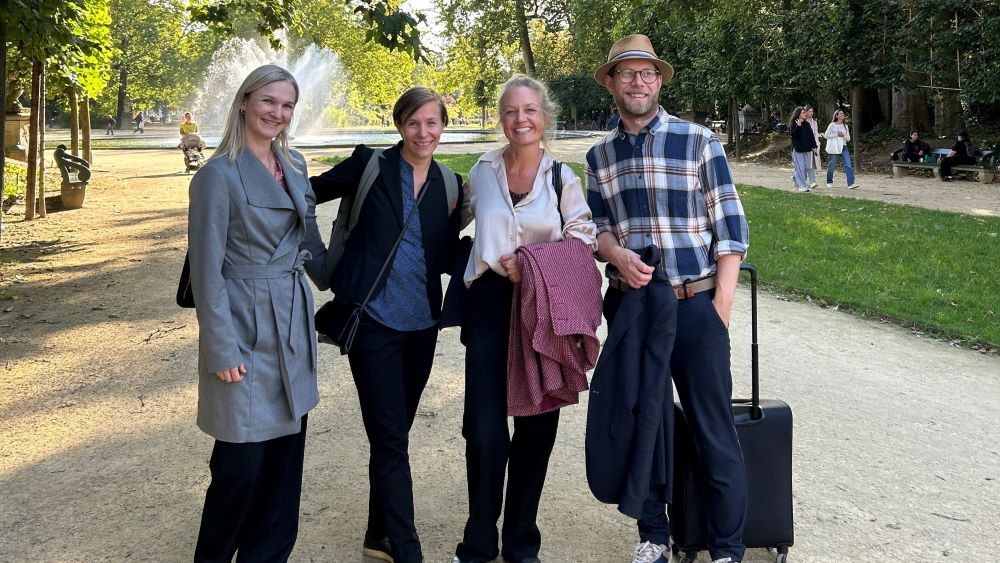
The English version of this article is translated by UiO GPT.
– After operating with limited resources last year, we have now established a strong research support team. I am thrilled that we have gathered so much expertise and experience within the faculty administration, says Marit Eldholm, Head of the Section for Research and Communication.
She is excited to start 2025 with a keen and highly qualified team in the research section.
– We work to provide support to the faculty's talented researchers when applying for funds from the EU and the Norwegian Research Council. Along with the local research support at departments and centers, we stay informed about calls, mobilize and guide researchers, and work systematically to provide strong support throughout both the application and operational phases of projects.
– In the research administrative network (FANE-SV), we collaborate closely to further develop the research support and find solutions to challenges related to external funding, she continues.
A strong professional team
– It’s very inspiring to have established such a strong professional team with expert knowledge in the areas we need at the faculty. We all have background from the social sciences ourselves, and altogether we have over 60 years of work experience from the University of Oslo, says Eldholm.
Hilde Henriksen is the most recent addition with a background in sociology and language. She has spent many years at the Faculty of Medicine, where she assisted several research groups that succeeded in EU collaborative projects. She has solid experience with the ERC and has coordinated internal processes related to calls for Centres of Excellence and national field evaluations.
Magnus Garder Evensen joined from the Faculty of Humanities in August and holds a master's degree in North American Studies. Magnus has substantial experience with the ERC and led the Faculty of Humanities' initiative to attract MSCA Postdoctoral Fellows, which has been highly successful and recognized internationally. As the head of UiO’s EU Resource Group, he was also responsible for UiO’s first competence day for research support in 2023.
Stina Petersen has been in the section for two years and has previously worked at both the Department of Sociology and Human Geography, and the Department of Economics. She has extensive experience with funding from the Norwegian Research Council and the EU, and has developed strong expertise in research infrastructure, data privacy in research, and general support regarding good management and operation of projects.
Together, the team will further develop collaboration in FANE-SV to ensure continued good research support. Contact points for academic staff remain the local research consultants/advisors at the faculty’s departments and centers.
Motivated by strong and societally relevant research
The Faculty of Social Sciences is notable for its strong research groups and international success, in particular with the ERC scheme.
– This is especially motivating for research support staff, and it's very fulfilling to contribute to enabling world-leading research, says Eldholm.
Eldholm is focused on creating strong communities where research support collaborates across boundaries through experience sharing and competence building.
– Cooperation and development are particularly important as the role of research support staff is dynamic and continuously evolving, she states. She also highlights the importance of good interaction between research and administration.
In this article, you can read more about what Eldholm considers success criteria for good collaboration: Goal-oriented work to reduce the distance between administrative and scientific staff (Forskerforum) (Norwegian only).
High ambitions for research support
– The ambition of research support is simply to provide academic staff with the best possible conditions to conduct their research, says Eldholm.
In addition to assisting with securing external funding, the team also provides support in areas such as research ethics and data privacy in research, and works to ensure the uptake of research also outside academia.
– Moreover, research infrastructure has become more important in recent years. With an explosive growth in computing power and tools, opportunities abound, and we aim to ensure that all our researchers, from social anthropologists to economists and psychologists, can utilize new methods and tools for collecting and processing research data. They also need good platforms to collaborate both internally and internationally. This requires solid expertise and good collaboration across units, both with the IT department and the Digital Scholarship Centre (DSC). The internal information flow becomes crucial, Eldholm concludes.
Who does what in the research team
Marit Eldholm
- Research strategy and advising
- Management and coordination of research administrative support services, including FANE-SV
Hilde Henriksen
- ERC (ISS, PSI)
- Thematic EU projects
- Research ethics
- Societal innovation/impact
Magnus Garder Evensen
- ERC (ARENA, ISV, SAI, TIK, ØI)
- Marie Skłodowska-Curie Actions (MSCA)
- FANE-SV
- Early career researchers
Stina Petersen
- Norwegian Research Council
- UiO interdisciplinary initiatives
- Research infrastructure and data management
- Personal data in research