Oscillatory mechanisms supporting human cognition

Duration
01.01.2016–01.01.2028

The primary objective of the research program is to acquire new knowledge about the fundamental electrophysiological mechanisms that enable working memory, prediction and attentional control in the human brain.

AI generated (Copilot) image of the brain with oscillatory activity.  

About the research program

These basic cognitive control functions mentioned are critical for goal-directed thinking and behavior, and are crucial aspects of cognition that enable humans to successfully engage their surroundings. We hope to elucidate how networks of neurons in the brain cooperate when people perform tasks that make demands on participants' focusing of attention, anticipating upcoming stimuli, working memory, and other cognitive control functions. It is our belief that this will facilitate identification of the neural mechanisms by which the frontal cortex controls distributed neuronal ensembles in other brain regions that are engaged during higher-order cognition.

Brain imagery. Illustration.

By recording electrophysiological activity from electrodes directly attached to the surface of the brain or implanted in the depth of the brain, we are beginning to gain novel insights into the brain's oscillatory dynamics when performing cognitive tasks. Our ability to record directly from the brain is possible due to a unique population of individuals that opt to have electrodes implanted in their brain. These electrodes aid doctors in the process of localizing epileptic activity prior to surgical treatment for drug-resistant epilepsy. This method is called intracranial EEG (iEEG). iEEG is a powerful technique with unparalleled temporal and spatial resolution that permits detailed examination of the dynamic interplay of cortical processing within local- and across distant brain regions. No other electrophysiological recording technique offers the same precision, timing, or ability to observe cognition in real-time.
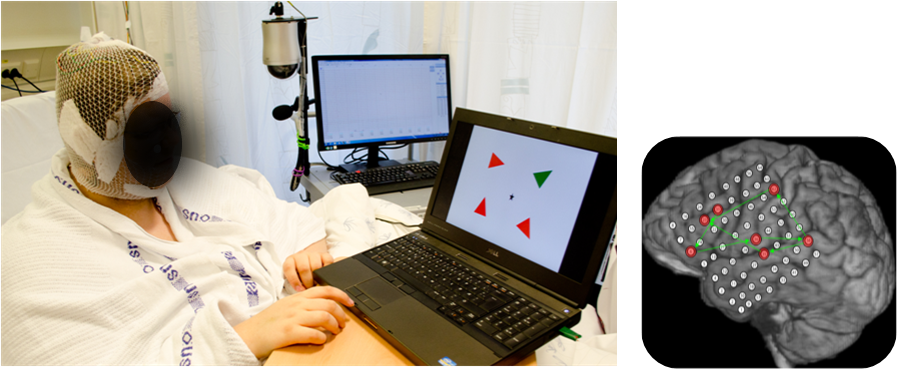
To the left: A man sitting in a hospital bed with a hood on his head that records EEG activity. On a table beside him is two computers. Photo. To the right: Brain imagery. Illustration.
Patient performing a test of attention and working memory during simultaneous registration of EEG activity recorded from intracranial electrodes.

Over the past few years, we have recorded data from the brains of the majority of adult patients who have undergone iEEG monitoring at the Department of Neurosurgery at Oslo University Hospital. All of these patients have participated in experiments designed to highlight the neural activity at work in directed attention and working memory. In conjunction with our iEEG recordings, we have also had the opportunity to record scalp-EEG data for the same experiments from neurological patients who have focal brain lesions (typically resulting from primary brain tumors) and from healthy volunteers. The integrated methodological approach that we utilize is beneficial because it allows us to test whether lesions to specific frontal regions disrupt the cognitive functions in question, and whether those regions play a key role in modulating the task-related electrophysiological activity we are interested in. By analyzing iEEG data, scalp-EEG data from neurological patients, and from healthy participants, we are able to examine how the brain manifests higher-order cognitive functions at varying levels of ability and what anatomical regions are required.

The Norwegian part of our team is composed of clinicians and researchers at the Department of Neurosurgery - OUS Rikshospitalet and the Department of Psychology/RITMO - University of Oslo. In collaboration with the Norwegian cohort are our colleagues at the University of California at Berkeley (USA). Data are recorded both at a Norwegian hospital and at US hospitals. Because iEEG data in Norway are only collected at Oslo University Hospital, combining data from Norway and the US greatly increases study participation and the feasibility of the program. Thus far, our international team has published high-impact scientific articles and given presentations at conferences on topics such as the characterization of bidirectional oscillatory communication that supports working memory; revealing neural mechanisms involved in predictive processes; defining a network of frontal and temporal regions that support top-down and bottom-up driven attention; and how the interplay between low and high frequency oscillations supports perception. More joint scientific reports have been submitted or are in preparation that are expected to provide new and groundbreaking insights into the neurophysiological basis of key cognitive control functions in the human brain.

Participants

  • Anne-Kristin Solbakk University of Oslo
  • Tor Endestad University of Oslo
  • Alejandro Omar Blenkmann University of Oslo
  • Vegard Akselsson Volehaugen University of Oslo
  • Vinicius Rezende Carvalho University of Oslo
  • Maja Dyhre Foldal University of Oslo
  • Anne Danielsen University of Oslo
  • Olgerta Asko University of Oslo
  • Julian Fuhrer University of Oslo
  • Ingrid Funderud
  • Sabine Liliana Leske
  • Anais Llorens University of Oslo and UC Berkeley, USA
  • Pål Gunner Larsson OUS-RH
  • Jugo Ivanovic OUS-RH
  • Torstein R. Meling National Hospital, Copenhagen, Denmark
  • Robert T. Knight UC Berkeley, USA
  • Julia Kam UC Berkeley, USA
  • Lisa Johnson UC Berkeley, USA
  • Randolph F. Helfrich UC Berkeley, USA & Univ. of Tubingen, Germany
  • Katarina Slama UC Berkeley, USA
  • Ulrike M Krämer C Berkeley/Univ. of Lubeck, Germany
  • Matthias Liebrand Univ. of Lubeck, Germany
  • Sepideh Sadaghiani UC Berkeley, USA
  • Macià Buades-Rotger Univ. of Lubeck, Germany
  • Anat Perry UC Berkeley, USA
  • Jamie Lubell Aarhus University Hospital, Denmark

Publications

  • Jesper Andersen, Olivier Lartillot & Stefania Serafin (2026). Exploring Real-Time Visualizations as Support for Concert experiences for Hearing-Impaired. In Sara Comai & Aikaterini Tzompanaki (Ed.), GoodIT '26: Proceedings of the 2026 International Conference on Information Technology for Social. Association for Computing Machinery (ACM). ISSN 9798400724831. p. 550–560. doi: 10.1145/3794786.3830797. Full text in Research Archive
  • Enrique Encinas, Andrew Morrison, Alexander Refsum Jensenius, Markéta Dolejšová & John Hill (2026). Rhythm and Residue: Vyping as Prompting Inside the Post-Discursive Interface. In Laura Havinen & Susanne Hägglund (Ed.), Adjunct Proceedings of the 14th Nordic Conference on Human-Computer Interaction. Association for Computing Machinery (ACM). ISSN 9798400727986. p. 1–9. doi: 10.1145/3821402.3830167. Full text in Research Archive
  • Markus Yuki Nishimura, Kohei Matsumoto, Jim Tørresen & Ryo Kurazume (2026). FLexible Multi-Robot Social Navigation Using Diffusion-Based Deep Reinforcement Learning. In Kazuo Ishii, Tomohiro Shibata, Ayanna Howard, Silvia Rossi & Aurélie Clodic (Ed.), Proceedings of The 35th IEEE International Conference on Robot and Human Interactive Communication (RO-MAN 2026). IEEE. ISSN 9798331588656. p. 2122–2127. doi: 10.1109/RO-MAN72286.2026.11714669. Full text in Research Archive
  • Enrique Encinas & Alexander Refsum Jensenius (2026). The Perfect Wrong Note: Vyping and the Keyboard as Musical Interface for Human-LLM Interaction. In Benedict Gaster & João Nogueira Tragtenberg (Ed.), Proceedings of the International Conference on New Interfaces for Musical Expression. The International Conference on New Interfaces for Musical Expression. doi: 10.5281/zenodo.20784433. Full text in Research Archive

View all works in NVA

  • Enrique Encinas, Andrew Morrison, Alexander Refsum Jensenius, Markéta Dolejšová & John Hill (2026). Rhythm and Residue: Vyping as Prompting Inside the Post-Discursive Interface. doi: https:/rhyres.craitr.no. Full text in Research Archive
  • Philippe Vendrix, Rebekah Ahrendt, Judith Irmela Haug & Olivier Lartillot (2026). COST Action EarlyMuse 2022-2026. Six Reports on Musicology in Europe. doi: 10.5281/ZENODO.22337344. Full text in Research Archive
  • Alexander Refsum Jensenius (2026). Jeg har aldri opplevd studenter som er mer KI-kritiske enn nå. Full text in Research Archive
  • Finn Upham (2026). Familiarity, performance function, and physiological synchrony in concerts. Full text in Research Archive
  • Jonna Katariina Vuoskoski, Persefoni Tzanaki, Lieke Dinie Maria Perik & Cagri Erdem (2026). Trait empathy facilitates rhythmic entrainment and interpersonal synchrony. doi: https:/www.jyu.fi/en/file-download/download/public/67529. Full text in Research Archive
  • Augustin Braud, Alexandra Büttner, Olivier Lartillot, Anna Katharina Laux, Laurent Pugin & Kristina Richts-Matthaei [Show all 10 contributors for this article] (2026). Formation of a Special Interest Group on Linked Metadata and Interoperability in Musicology: Report and Results from the International Musicology Workshop Held Between NFDI4Culture, musica*, RISM and the MishMash Centre for AI and Creativity. doi: 10.5281/ZENODO.22868638. Full text in Research Archive
  • Jim Tørresen (2026). Tutorial: Ethics in Embedded Systems and Robots. Full text in Research Archive
  • Jim Tørresen (2026). Embedding Intelligence in Robots Through Interdisciplinary Collaboration. Full text in Research Archive
  • Dana Swarbrick & Suvi Saarikallio (2026). An Exploratory Study on How AI Song Generation Affects Emotions, Agency, Authenticity, Creativity, and Connectedness in Musicians and Nonmusicians. doi: https:/osf.io/pucj2. Full text in Research Archive
  • Alexander Refsum Jensenius (2026). A summer of Still Standing. doi: https:/www.uio.no/ritmo/english/news-and-events/events/food-and-paper/2026/20260916_alexander-refsum-jensenius/index.html. Full text in Research Archive
  • Enrique Encinas & Alexander Refsum Jensenius (2026). The Perfect Wrong Note: Vyping and the Keyboard as Musical Interface for Human-LLM Interaction. doi: 10.5281/zenodo.20784433. Full text in Research Archive
  • Alexander Refsum Jensenius (2026). Kreativ KI: en introduksjon. Full text in Research Archive
  • Alexander Refsum Jensenius (2026). Reflections on Live Concert Research. Full text in Research Archive
  • Jim Tørresen (2026). 2nd Workshop on Robot Ethics – Ethical, Legal and User Perspectives in Robotics and Automation (WOROBET). Full text in Research Archive
  • Alexander Refsum Jensenius, Joel Clinton Glover, Finn Upham & Annabel Balean Guaita (2026). MusicLab Listening Body Bergen Panel Discussion. doi: https:/www.uio.no/ritmo/english/projects/musiclab/2026/listening-body-bergen/index.html. Full text in Research Archive
  • Alexander Refsum Jensenius, Joel Clinton Glover, Finn Upham & Annabel Balean Guaita (2026). MusicLab Listening Body Oslo Panel Discussion. doi: https:/www.uio.no/ritmo/english/projects/musiclab/2026/listening-body-oslo/index.html. Full text in Research Archive

View all works in NVA

Funding

Funded by The Research Council of Norway

Project number: 262762

Collaborators

  • OUS Rikshospitalet
  • University of California, Berkeley
Published Jan. 24, 2025 1:42 PM - Last modified Feb. 6, 2025 1:14 PM