Background
The complement system comprises over 50 soluble and membrane-bound proteins, and its activation occurs via three major pathways: the classical, lectin and alternative, all of which converge on the central components C3 and C5, generating C3a and C3b as well as C5a and C5b, which have multiple different functions during inflammation 1. Mostly extracellular complement activation was addressed by multiple research groups, until recent 15 years, when intracellular complement cleavage and activation was first described 2,3.
C5a acts as a potent pro-inflammatory mediator through C5a receptor R1 (C5aR1) expressed on multiple cell types including immune cells. After binding to C5a, C5aR1 initiates pro-inflammatory signaling and cytokine release to alert immune system about infection or injury.
The precise mechanisms, timing, contribution of intracellular complement complexes to complement-mediated effects during various types of inflammation remains almost unexplored, including the interplay with other danger signal sensors like Toll-like receptors or cGAS-STING DNA-sensor system (Figure).
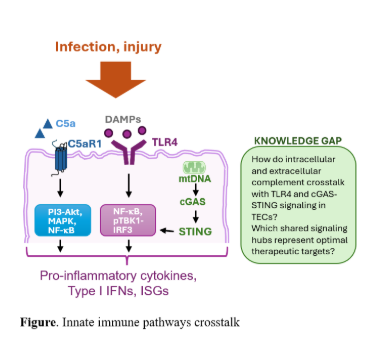
Overall, complement proteins, TLR4 and cGAS-STING recognize different danger signals but converge with complement on overlapping inflammatory pathways. Emerging evidence suggests the significant crosstalk between these pathways during sterile inflammation 2,4, and the mechanistic insights about the interplay and mutual regulation for these pathways may allow the development of new anti-inflammatory therapies.
Overall, intracellular complement contributes to inflammation induced by pathogens (infection) and trauma, injury (sterile inflammation. Within this project there are several lines of investigation to uncover how intracellular complement is activated and reciprocally regulated by several innate immune signaling pathways (TLRs, cGAS-STING).
Possible research questions
Activation and trafficking of intracellular complement proteins – C3, C5, C5aR1, localization in different cell types, regulation by TLR4 or cGAS-STING, reciprocal regulation
Mitochondria function regulation by intracellular C5a-C5aR1 signaling axis
Methodology
- Cell culture work, cell stimulation, applying signaling inhibitors
- Flow cytometry for surface proteins
- ELISA for cytokine secretion
- Western blot analysis for phosphoproteins analysis
- Immunoprecipitation for detecting protein complexes combined with Western blotting
- Possible: quantitative PCR, confocal microscopy
Some references
- Nesargikar, P. N., Spiller, B. & Chavez, R. The complement system: history, pathways, cascade and inhibitors. Eur J Microbiol Immunol (Bp) 2, 103–111 (2012). https://doi.org/10.1556/EuJMI.2.2012.2.2
- Niyonzima, N. et al. Mitochondrial C5aR1 activity in macrophages controls IL-1beta production underlying sterile inflammation. Sci Immunol 6, eabf2489 (2021). https://doi.org/10.1126/sciimmunol.abf2489
- West, E. E. & Kemper, C. Complosome - the intracellular complement system. Nat Rev Nephrol 19, 426–439 (2023). https://doi.org/10.1038/s41581-023-00704-1
- Decout, A., Katz, J. D., Venkatraman, S. & Ablasser, A. The cGAS-STING pathway as a therapeutic target in inflammatory diseases. Nat Rev Immunol 21, 548–569 (2021). https://doi.org/10.1038/s41577-021-00524-z