
Lurv, or turf algae, are a formless mass of intertwined filamentous algae in which individual organisms are difficult to distinguish from one another. Lurv forms as a result of uncontrolled growth of fine, opportunistic algae, including tubular branched and unbranched species, benthic diatoms, and filamentous cyanobacteria (blue-green bacteria). It may occur both as attached growth and as loose-lying mats. The presence of lurv indicates poor ecological status or negative impacts on the ecosystem when it occurs in large amounts. These algal mats can replace native perennial and habitat-forming species such as kelp and eelgrass on rocky or sediment bottoms, and can overgrow and smother seaweeds, kelp, and eelgrass.
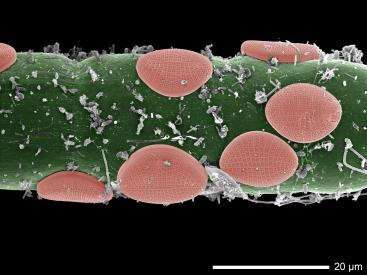
In this project you will work in Oslofjorden and concentrate on the photosynthetic microbes, mostly diatoms and blue-green bacteria living within the turf. You will follow the development of the turf during the growth season (March–October) and study the species composition of diatoms and blue-green bacteria in light and electron microscopy. The goal is to describe how the community changes over the growth season.
 |  |
 |  |