This text has been translated from Norwegian with the assistance of GPT UiO.
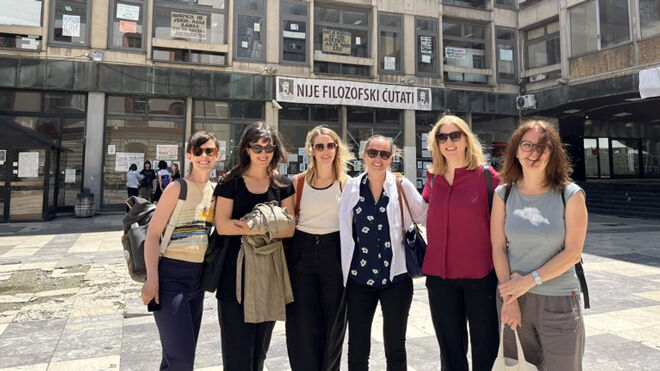
– It was incredibly interesting to step inside the doors of the blocked faculty buildings and hear directly from university staff about what everyday life is like during the blockade, says Lara Kristiansen.
– Especially considering how little the situation has been covered by the media. Those who welcomed us were very open, friendly, and everything proceeded peacefully.
Kristiansen is administratively responsible for the TIK study programme within the PhD programme. Together with six colleagues from institutes, centres, and the faculty administration, they form the administrative PhD network at the SV faculty.
A camp for academic freedom
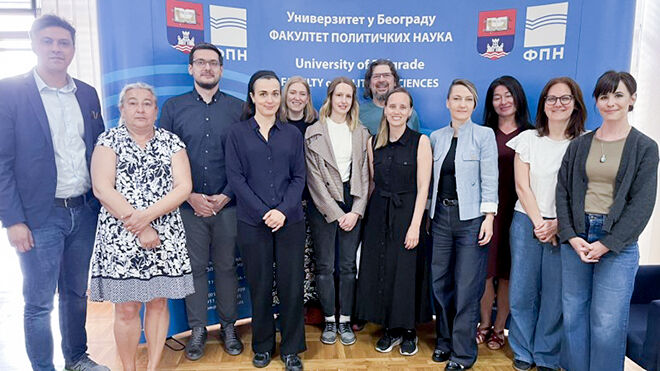
The network is coordinated by Ingebjørg Hovde. She explains they were permitted to visit two faculties: the Faculty of Philosophy and the Faculty of Political Science, even though the university was closed and had not conducted classes since December.
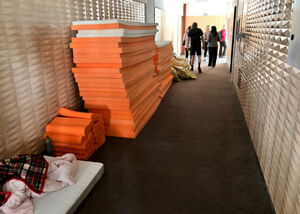
Outside the lecture halls, there were piles of mattresses because students, according to Hovde, sometimes sleep overnight at the university. Some lecture rooms had been converted into kitchens.
She further explains that in Serbia, police are legally prohibited from entering university buildings without permission from the rector/dean of the respective faculty.
Since the university leadership, led by the rector, supports the students, it is safe for protesting students to remain within the university buildings.
For the administrative PhD network, the trip served as a reminder that academic freedom should not be taken for granted.
– For us, the trip placed not only research education but also the societal role of universities into perspective. It became clear once more how crucial it is to protect academic freedom, says Kristiansen.
Well organised
– It left a strong impression on all of us to witness what students and staff are facing and how well-coordinated and steadfast they remain despite the pressure they are experiencing, she continues.
Overall, they believe the trip was valuable for both the internal collaboration within the network and for potential future collaborations with Belgrade.
Khrono is among the few media outlets that have covered the events in Serbia (in Norwegian) since the demonstrations started following the roof collapse in Novi Sad, where 16 people were killed on 1 November 2024. Roughly six months later, students continue to block most universities in Serbia.
According to Khrono, the students peacefully protest against corruption in the country, demanding an independent investigation into how the roof could collapse and the public release of all documents related to the procurement and construction of the Novi Sad train station.
Mari Eidstuen, phd responsible at ISV, points out that the accident in Novi Sad was only the trigger for the protests, while the blockade of the universities has more deep-seated causes.
– The students are fighting against corruption and demanding fair democratic elections. They experience broad support from the population and universities in Serbia, she emphasises.
Eventful and exciting
– The purpose of the trip was to visit a Circle U university and gain insights into their research education.
– Additionally, we wanted to foster connections within the PhD network across different units, says the faculty's PhD coordinator Ingebjørg Hovde.
Liv Christina Varen, in charge of the SAI study programme within the PhD programme, responds that she gained a lot from the trip.
– It was incredibly useful to map out both similarities and differences in the organisation of studies and research education at our two universities. Meeting people in person also lowers the threshold for further contact and potential future collaborations, she informs.
– We gained new perspectives on the potential significance of European university alliances, adds Hovde.
The week after the network visited the Circle U university, the Circle U Democracy Hub organised a summer school in Belgrade. In conjunction with this, a panel discussion was held about the situation, “Voices of Resistance: The Role of Student Protests in Shaping Serbia's Future.”
According to Hovde, five master's students from the SV faculty participated.
– We all probably agree that this turned out to be a much more unique and exciting trip than we had anticipated, concludes the PhD coordinator.