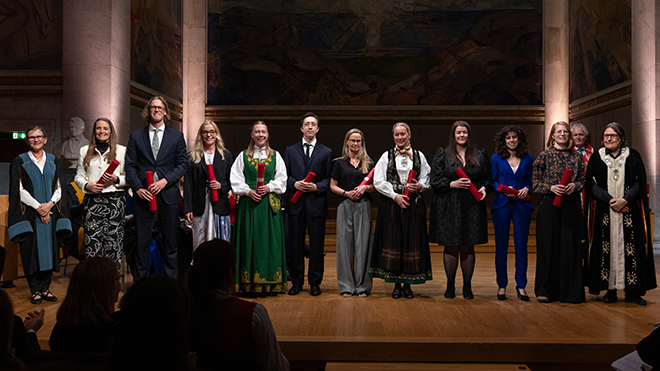
We are immensely proud of our twenty candidates who are here today to receive the degree of doctor from the Faculty of Social Sciences. The Faculty ranks highly internationally and conducts research on democracy, nuclear policy, social and economic inequality, extremism, migration, mental health, urban development, tax policy, the green transition, and many other exciting topics.
The candidates receiving their diplomas today are from the fields of psychology, political science, sociology and human geography, and technology, innovation and culture.
Presentation
It is my pleasure to invite the first ten candidates to come up onto the stage:
- Randi Hovden Borge
- Elettra Capogna
- Kristin Espenes
- Heidi Fjeldheim
- Trude Fredriksen
- Øyvind Øde Vy Halsøy
- Pia Myklebust Johannessen
- Ruth Eva Jørgensen
- Eivind Hjort Matthiasen
- Monica Beer Prydz
I ask the candidates to take one step forward as their theses are presented.
Borge investigates why open‑plan offices are associated with higher sickness absence than home offices, and shows that both the degree of job autonomy and differences in sickness presence – that is, going to work even when ill – may be important explanations.
Capogna examines how the brain changes as we age, and shows that older adults who maintain good memory have healthier brain structure, better communication between brain regions and protective chemical substances in the brain.
Espenes investigates how evidence‑based measures can strengthen emotion regulation and mental health among young people in residential child welfare institutions, and shows that tailored interventions can help – but also that they must be implemented more effectively to achieve lasting results.
Fjeldheim shows that early therapy for expectant and new parents can help to break negative patterns from their own upbringing, but that this requires empathetic, clear‑thinking therapists who can stand firm when things become turbulent.
Fredriksen shows that siblings of children with chronic illness may be at increased risk of mental health problems, particularly when the relationship with parents is insecure and everyday life is demanding – whereas good communication within the family can serve as a protective factor.
Halsøy examines how the COVID‑19 pandemic affected people with chronic illnesses, rare diagnoses and their families, and finds that they experienced persistently high levels of mental health problems even after the situation improved for the rest of the population.
Johannessen shows that the adult population in general remained resilient throughout the pandemic, but that some vulnerable groups experienced increases in anxiety disorders, eating disorders and self‑reported psychological difficulties.
Jørgensen’s thesis shows that our genetics also influence the risk of relationship breakdown. Another finding is that break‑ups run in families, but this is not only due to what we learn at home – we also inherit genes from our parents that play a role.
Matthiasen has interviewed people with different class backgrounds in Greater Oslo, and shows that social class shapes how we use electricity in everyday life – and that energy transitions are not experienced as equally fair by everyone.
Prydz has studied a digital programme based on “Five Steps to Greater Everyday Joy”, and shows that ten weeks with this intervention lead to improved quality of life, more positive emotions and fewer symptoms of anxiety and depression.
On the basis of the recommendations from the appointed experts and from the Faculty, the Rector has decided to confer on you the degree of doctor. I invite the Rector to present the diplomas.
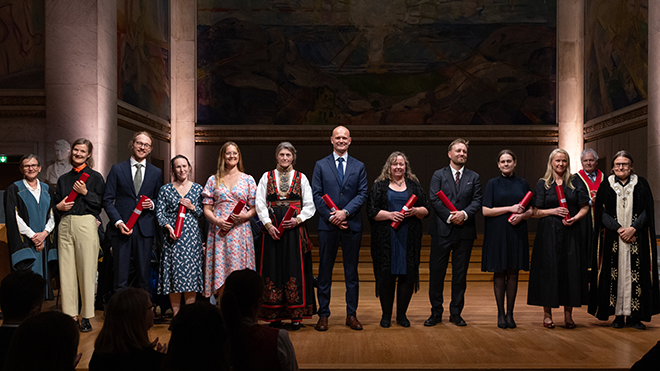
I now invite the next ten candidates to come up onto the stage:
- Anita Myhre Ramborg
- Anna Eriksen Rio
- Sverke Runde Saxegaard
- Sidsel Louise Schaller
- Peter Halvard Voss Sele
- Lynn Skei
- Kari‑Elisabeth Vambeseth Skogen
- Anne Kristine Nilsen Solhaug
- Johannes Rudjord Volden
- Erica Zahl
Ramborg shows that living with a rare condition that is visible in the body and face is about far more than medical treatment. Stigma, social support and long‑term follow‑up are crucial in shaping how life is lived.
Rio examines how so‑called free economic zones function in Ethiopia, and shows that zones promising freedom from bureaucracy may in practice result in greater state presence and control.
In his thesis, Saxegaard shows that the risk of new civil wars is linked to whether executive power is constrained, whether the losing side is politically included, and how peacekeeping forces are used in the aftermath of war.
Schaller investigates how older people experience and express sexuality, and shows that sexual health and wellbeing are strengthened when they are met with respect, receive good information and are not confronted with age‑discriminatory attitudes.
Sele examines how best to help people with complex PTSD following childhood violence and sexual abuse, and shows that early, direct work with traumatic memories can be more effective than traditional phase‑oriented therapy.
Skei shows that people with CHARGE syndrome often mature cognitively at a later stage, but can develop well when they receive early, tailored measures that reduce the consequences of limited visual and auditory input.
Skogen provides an insider’s view of how research is used, adapted and sometimes set aside within the central government administration, thereby offering a rare and detailed picture of the relationship between knowledge and governance.
Solhaug has studied quality of life among unaccompanied minors on the move, and finds that they struggle with the after‑effects of trauma and the uncertainty of the asylum process, but also that a simple group intervention can lead to noticeable improvement.
Volden investigates how Norwegian consumers experience replacing meat with plant‑based alternatives and edible insects, and shows which practical obstacles stand in the way in everyday life.
Zahl finds that parents’ mental health is often strained when a child has a chronic illness, and points out that the health services must give fathers a clearer role and systematically assess how both parents are coping.
Conclusion
On the basis of the recommendations from the appointed experts and from the Faculty, the Rector has decided to confer on you the degree of doctor. I invite the Rector to present the diplomas.