This text has been translated from Norwegian with the assistance of GPT UiO.
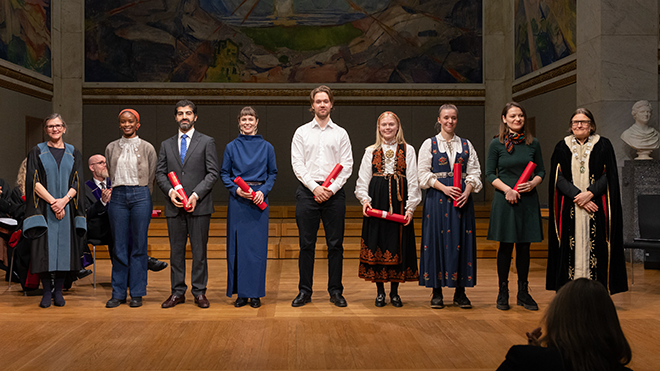
We are immensely proud of our fourteen candidates who are present today to receive their doctoral degrees from the Faculty of Social Sciences. The faculty ranks highly internationally and conducts research on democracy, nuclear politics, social and economic inequality, extremism, migration, mental health and illness, urban development, tax policy, the green transition, and many other exciting topics.
The candidates receiving their diplomas today come from the fields of psychology, political science, sociology, and technology, innovation and culture.
Presentation
It is my pleasure to invite the candidates to the podium:
- Olgerta Asko
- Solveig Bjørkholt
- Ingvild Vøllo Eliassen
- Axel Peter Kristensen
- Guro Engvik Løseth
- Ari Aziz Karim Mamshae
- Bintu Zahara Sakor
- Lisa Adina Scordato
- Gro Stueland Skorpen
- Anette Stamland Solvi
- Bente Sommerfeldt
- Tor Gaute Syrstad
- Rishabh Tyagi
- Gina Åsbø
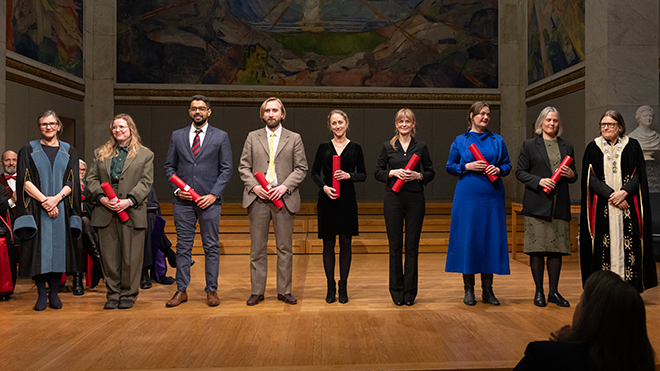
I kindly ask the candidates to take one step forward as their thesis is presented.
Olgerta Asko’s work shows that the prefrontal cortex helps us anticipate sounds and detect when something unexpected occurs. This is demonstrated through studies of patients with injuries in these brain regions and through direct measurements from the brains of epilepsy patients.
Solveig Bjørkholt’s thesis shows that international standardisation is not merely a technical process. It is influenced by political negotiations and demands for legitimacy, in much the same way as other political processes.
Ingvild Vøllo Eliassen’s research shows that short cognitive tests alone are not sufficient to identify early signs of dementia. However, they may still be useful for measuring changes over time, as individuals in the early stages of Alzheimer’s disease show a more rapid decline in memory and complex tasks.
Axel Peter Kristensen’s work demonstrates that economic uncertainty makes people less inclined to have children. At the same time, an increase in relationship break-ups means that men who enter partnerships with someone who already has children are more likely to remain childless.
Guro Engvik Løseth’s thesis shows that we do not need endorphins to experience the positive effects of social support. This gives hope for patients with alterations in the brain’s reward system.
Ari Mamshae’s research shows that appointments to high-ranking bureaucratic positions are based on a complementary mix of political loyalty, competence and representation.
Bintu Zahara Sakor’s doctoral dissertation examines why youth programmes in sub-Saharan Africa succeed or fail. It shows how state-led initiatives, young people’s own perceptions and gender-based barriers together influence the prospects for demographic development.
Lisa Adina Scordato’s thesis investigates how local governance in Norway and Italy deals with unforeseen crises. It shows that the public sector meets the unknown through a combination of professional expertise, practical wisdom and institutional trust.
Gro Stueland Skorpen has studied how the Office of the Auditor General of Norway works. An important finding is that auditing is in the process of shifting from merely overseeing public administration to also aiming to contribute added value to the bureaucracy.
Anette Stamland Solvi’s research shows that system failures can overburden foster parents, and that tailored support is needed to ensure stability and prevent re-placements.
Bente Sommerfeldt’s thesis shows that there is an increased risk of relapse into eating disorders during pregnancy and the postpartum period. Healthcare personnel should prioritise identifying and understanding women’s experiences of symptoms throughout this time.
Tor Gaute Syrstad’s work investigates the presence of anger and fear regarding societal developments and developments within specific policy areas in Norway, including the future of the welfare state.
Rishabh Tyagi’s dissertation shows that labour market uncertainty affects important aspects of life, including the risk of depression, divorce and fertility.
Gina Åsbø’s research finds that most people with schizophrenia or bipolar disorder experience significant improvement over a ten-year period, and have themselves contributed greatly to this improvement through clear recommendations for services.
Conclusion
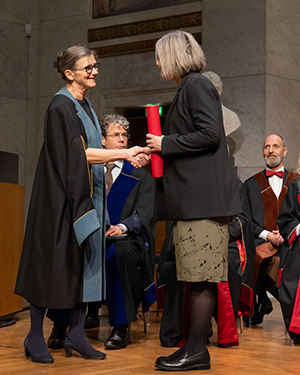
Based on the recommendations of the appointed experts and the faculty, the Rector has decided to confer upon you the degree of doctores. I now invite the Rector to present the diplomas.