In our recent research in the oil and gas sector, we started observing the phenomena of ‘climate quitting’. For our research, we interviewed dozens of people, and got a sneak preview of our results published in ‘the Conversation’.
News - Page 10
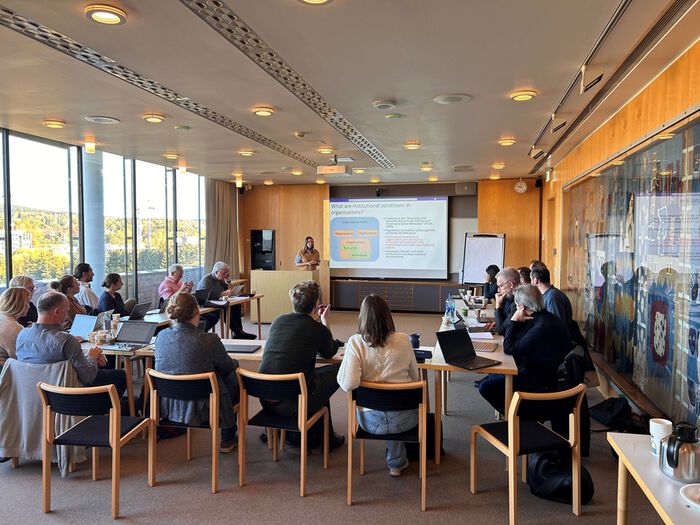
On October 12th 2023, the OSIRIS consortium gathered in Oslo for a one-day meeting.
An important (and somewhat contentious) question in the energy transition is the role of large established actors, like oil and gas companies. We know these companies have a lot of resources, competencies, and influence that could contribute to a transition, but we also know they are companies that may benefit from the status quo. This means that how established organizations change and react to change, becomes an important question. We sat down with PhD candidate, Hannah Schupfer, to learn more about her research into these questions.
Applications are invited for 1 PhD position in social anthropology, to be based at the Department of Social Anthropology, University of Oslo. The position will be part of the project “Amber Worlds: A Geological Anthropology for the Anthropocene (AMBER)” led by Associate Professor Alessandro Rippa, and funded by the European Research Council. The contracts will commence in spring 2024, run for 3-to-4 years (see below), and the location of employment is Oslo, Norway.
DEADLINE 03.09.2023
Applications are invited for 2 post-doctoral positions in social anthropology, to be based at the Department of Social Anthropology, University of Oslo. The positions will be part of the project “Amber Worlds: A Geological Anthropology for the Anthropocene (AMBER)” led by Associate Professor Alessandro Rippa, and funded by the European Research Council. The contracts will commence in spring 2024, run for 3-to-4 years (see below), and the location of employment is Oslo, Norway.
DEADLINE: 03.09.2023
In September OSIRIS Ph.D. candidate Frauke Rohden submitted her thesis. Congratulatins, Frauke!
Last week Silje Maria Tellmann from OSIRIS took part in a panel on ‘The Blind Spots in Impact Research’ at CHER2023 in Vienna together with Stefan DeJong (Erasmus University Rotterdam), Reetta Muhonen (Tampere University) and Rachita Munshi (Erasmus University Rotterdam).
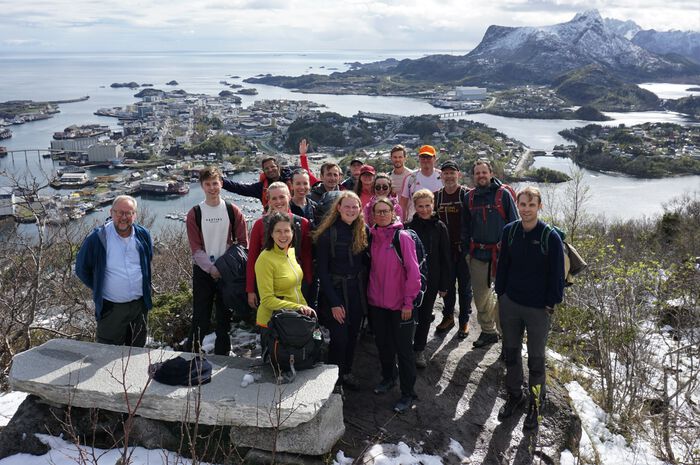
INTRANSIT gathered in Lofoten to reflect on our research and discuss avenues for further work. Among fishing boats and shipbuilders in Svolvær, we discovered we have much to say about industrial transformation. And among June snow and mid-night sun, our fantastic group of people had a chance to connect.
OSIRIS is hosting a track at this year's Eu-SPRI conference, which will take place at the the University of Sussex from 14 to 16 June.
Call for abstracts to workshop in Oslo, October 13, 2023. The workshop is hosted by OSIRIS researchers Magnus Gulbrandsen, Jakob Edler, Jordi Molas Gallart and Silje Maria Tellmann.
Valentin is a Ph.D. candidate in sociology of science at the Humboldt-Universität zu Berlin and a researcher at the Fraunhofer Center for International Management and Knowledge Economy IMW in Germany. He is currently also a visiting researcher at OSIRIS.
The IUROPA project launched the CJEU Database in January 2023. It is the most comprehensive research-oriented database on the Court of Justice of the EU.
Many countries with abundant natural resources experience lower economic growth than countries with little or no natural resources. In the economics literature this is referred to as the "resource curse". One reason put forward is lack of technological progress. In a recent study, we have examined a related issue, that is, whether a resource curse may occur due to the wrong type of technological progress, write Greaker, Heggedal and Rosendahl.
Many countries with abundant natural resources experience lower economic growth than countries with little or no natural resources. In the economics literature this is referred to as the "resource curse". One reason put forward is lack of technological progress. In a recent study, we have examined a related issue, that is, whether a resource curse may occur due to the wrong type of technological progress.
Early career researchers gathered at the EUI in Florence to discuss how large datasets on courts can advance understanding of judicial behaviour.
Earlier this year, Osiris had the pleasure to welcome postdoctor Knut Jørgen Vie to the team.
Lars Wenaas is the first Osiris Ph.D. candidate to submit his doctoral thesis. The thesis looks at the effects of open access. The public defense will take place at the University of Oslo on 11th November 2022.
Frauke Rohden, Ph.D. candidate at TIK and part of the OSIRIS team, is in the final stages of her Ph.D. work. In her thesis she looks at the role of informal science-oriented online activities for the diffusion, understanding, and use of scientific knowledge. We decided to ask Frauke some questions about her project.
How does science make its way from academic research into society? There is agreement that the connection between science and society is not a linear or simple process. This blog post presents six perspectives on the complexity, long timespans and many different actors involved in scientific impact processes.
From June 1-3 2022, the Osiris team attended the yearly Eu-SPRI conference. This year’s theme was “Challenging Science and Innovation Policy” and the aim was to explore future directions for studies of Policies for Research and Innovation with a special emphasis on the topics of Digitization, Open Science and Futuring.
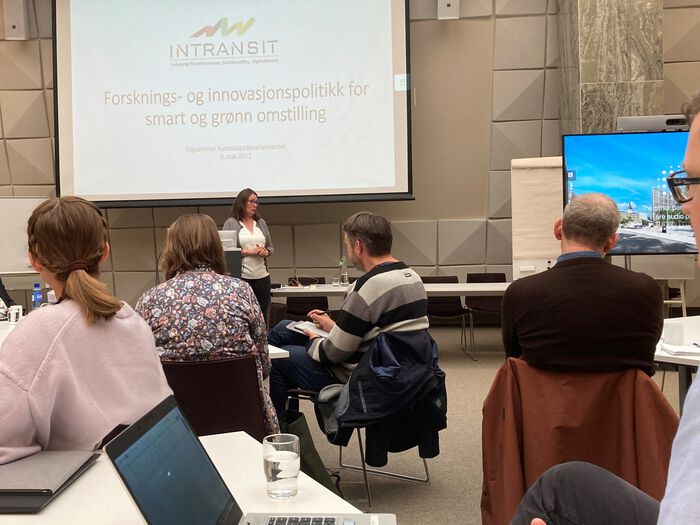
A challenge in transitions is how to efficiently link research with policymakers' current issues, problems, and questions. With that in mind, INTRANSIT, the Norwegian Research Council, and the Ministry of Education and Research hosted a seminar for informal discussions between researchers and bureaucrats from different ministries.
After more than two years of zoom meetings, the Osiris consortium finally met physically again for a two-day meeting in Valencia, Spain. The meeting was hosted by Osiris partner INGENIO and took place at their offices at Ciudad Politécnica de la Innovación.
How does science make its way from academic research into society? There is agreement that the connection between science and society is not a linear or simple process. This blog post presents six perspectives on the complexity, long timespans and many different actors involved in scientific impact processes.
Centre director, Taran Thune, has contributed to a new report on how missions can be used for tackling grand societal challenges in Norway.
Osiris is happy to welcome two new members to the team: Mayra Morales Tirado from University of Manchester and Gemma Derrick from University of Bristol.