Published
Dec. 18, 2025 4:32 PM
Martin Blomhoff Holm receives NOK 12 million to investigate whether the availability of housing can explain the falling birth rates.
Martin Blomhoff Holm receives NOK 12 million to investigate whether the availability of housing can explain the falling birth rates.
Liisa Raud gets 2 million kroner from the Reaserch Council of Norway to elaborate a cutting edge idea on the role of sleep in toddlers motor development.
The Hungarian justice system seems independent of party politics on paper. Reality is different. How does the regime manage to keep thousands of judges under control?
Looking at questions like "How do we understand Agency and Reform in promoting Women’s empowerment in peacebuilding?" and "What are the challenges of women’s participation in local peace processes?" the ERC-project ResilienceBuilding, brought together scholars and practitioners for a 3-day conference with an interactive discussion format.
Tore Wig will research the conditions for science in autocracies and Manjana Milkoreit the long-term governance of climate challenges. Both receive two million euros from the EU’s prestigious ERC Consolidator Grant. Congratulations!
Manjana Miloreit wants to understand how to enable leaders, institutions, and communities to think and act on time horizons that match the pace of Earth system change. The professor at the Department of Sociology and Human Geography receives two million euros from the EU's prestigious Consolidator Grant to do so.
Will scientific progress slow down if more countries in the world become autocratic? That is one of the questions political science professor Tore Wig will seek to answer with two million euros from the EU’s prestigious Consolidator Grant.
The Academic Breakfast Club is a brand-new breakfast seminar series that offers professional development for researchers at the Faculty of Social Sciences, accompanied by coffee and baked goods. Nearly sixty people found their way to the opening event in the series, which focused on how to succeed in grant writing.
Lars Erik Kjekshus thinks teaching is a mystery he will never fully solve: – If you believe you are an absolutely brilliant lecturer and have nothing left to learn, you should take that as a sign that you aren't.
Hungary is backsliding and is no longer a democracy. Why should the EU intervene when the democracy of a club member weakens?
Ola Innset from TIK is this year's winner of the Eilert Sundt research award, which is awarded by Oslo Arbeidersamfunn. The awardee is pleased that his research has relevance beyond academia.
The Centre for Lifespan Changes in Brain and Cognition (LCBC) at the Department of Psychology has received NOK 2 million from the Research Council of Norway to build a Nordic research network that will digitalise historical health registries and population data.
The research project and group Stakes of Democracy (University of Oslo) is offering a PhD course at the Centre Universitaire de Norvège à Paris.
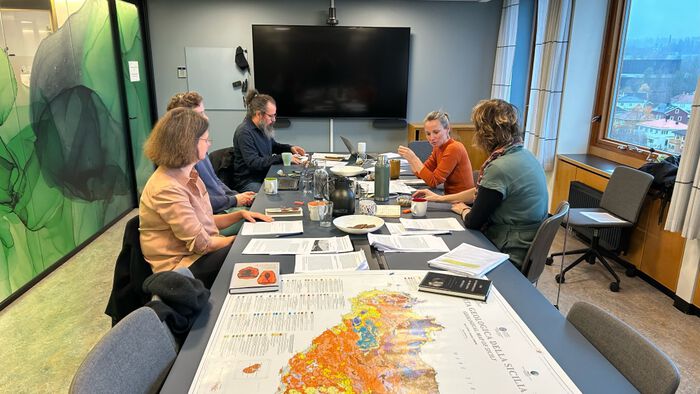
On November 7 the AMBER team convened a small workshop to discuss manuscript drafts on landscapes and their histories.
They make up almost half of the new convergence environments at UiO. The groups will investigate the role of endorphins in substance addiction, how contraceptives affect women’s mental health, and what drives neurodevelopment and divergence.
Alessandro recently joined Nadège Rolland of the National Bureau of Asian Research to discuss the history of China’s engagements with its Southeast Asian neighbours.
Federica Mogherini held the annual ARENA Lecture 2025. Watch the recording here.
Neurodevelopmental conditions, embryonic development, biodiversity, cancer control, medications, addiction, mental health and drug delivery are topics the new convergence environments will explore.
We have a vacant 2 year research position at the Department of Social Anthropology
Paper Title: Child is the mother of woman: Making of the relational individual at a counseling training program in India
Meghna Roy hosts a podcast episode for a series she co-created with Eleni Kotsira and Julia Khan as part of a public anthropology initiative by the European Network for Psychological Anthropology (ENPA).
Supported by Shrinking the Planet and the Department of Social Anthropology at the University of Olso the European Network for Psychological Anthropology held its biennial conference in Oslo in June 2023.
Who gets elected in Swedish politics, and whether elected politicians differ from the rest of the population, were among the themes that this year’s Eilert Sundt lecturer, Torsten Persson, addressed.
ARENA hosted a two-day workshop, gathering researchers to discuss the crisis of democratic representation in Europe and strategies for reconnection.
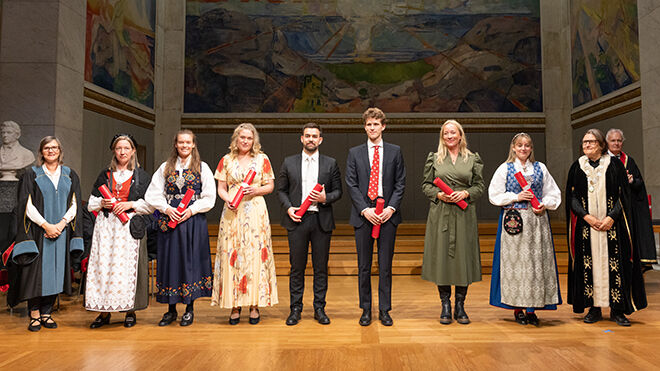
During a solemn ceremony in the Aula on 25 September, eight candidates from the faculty were conferred. Here is the Dean’s presentation of the candidates.