Published
Dec. 17, 2024 11:09 AM
Jemima García-Godos considers it a privilege to contribute to the development and learning of young people. Today, she receives the status of a distinguished educator.
Jemima García-Godos considers it a privilege to contribute to the development and learning of young people. Today, she receives the status of a distinguished educator.
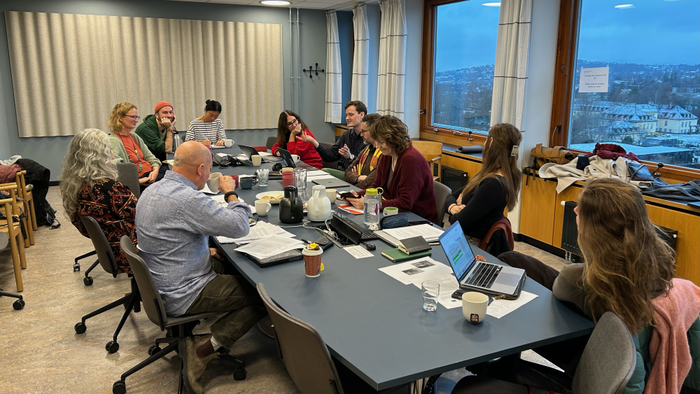
On December 6 the AMBER team, together with the “Forms of Ethnography – Ethnography as Form” research group, organised a writing-focused workshop at SAI.
On November 8th, 160 participants from academia, as well as the public and private sectors, gathered for the final event. The conference summarized the results from eight years of research conducted by OSIRIS and its sister center, R-QUEST (Centre for Research Quality and Policy Impact).
Siri Leknes at the Department of psychology receives the prestigious Consolidator Grant of 2.5 million euros to research how humans react to strong painkillers.
Magnus Gulbrandsen at TIK Centre for Technology, Innovation and Culture receives 7.6 million NOK from the Research Council of Norway to investigate how research in the health sector is utilized.
Julien Mayor and Kristin Martinsen at the Department of Psychology receive innovation funding from the University of Oslo to develop apps that can assess children's early language development and assist concerned parents.
"Knowledge about Europe and the EU is more important than ever," says ARENA's new director starting in the new year.
Manudeep Bhuller from the Department of Economics is participating in an interdisciplinary task force looking into measures for children and young people committing serious crimes.
As part of the 25th anniversary programme of the Nordic Embassies in Berlin, the Nordic Embassies, in cooperation with the University of Oslo and Humboldt-Universität zu Berlin, hosted a talk and panel discussion titled “Stakes of Democracy: Trust, Nature and Value in Times of Crises”.
Academic environments at the Faculty of Social Sciences are among the top five UiO disciplines in the latest Shanghai ranking.
Does asking researchers about the potential impact of their planned research have an impact? The need to solve grand societal challenges has increasingly moved to the fore in terms of legitimising public spending on research. Correspondingly, the potential societal impact of applicants’ proposed research projects is now commonly incorporated into research funders’ selection procedures. This shift does not seem to reduce the emphasis on excellence.
The evaluation of research impact has typically sought to assess the value of a research investment – an organisation, a funding programme, or a project. Focusing on the investment and connecting it to consequential outputs and impacts provides a clearly definable methodological starting point for evaluating impact. But research has value only in its use. So, what evaluation challenges appear if we want to shift our eye to the perspective of research users? How can we trace their roles in multiple processes of research valorisation and appreciate how they benefit? Sounds difficult. Here we propose five methodological principles for getting started.
The Department of Psychology is announcing the 2025 Open Science Award, and we need your nominations!
This year, students write about the human rights of migrants, the European Green Deal, and political parties’ views on democracy.
We mark the occasion by inviting to a public conference showcasing ARENA’s research and reflecting on 30 years of the Nordic countries’ EU experiences.
The hiatus between the various editions of the UK REF exercise always seems to lead to debate about its future. Is it too expensive? Is it too burdensome? Is it the best way to allocate performance-based funding? Seven years ago, we looked at the relationship between the 4* research and 4* impacts submitted to REF 2017. Then, we found that the relationship between excellent research and societal impact in most fields was heterogenous, leading us to posit this diversity as a strength of the UK university system. Here we do the same for REF 2021, to see what has changed and consider whether there are any implications to be drawn for the proposed REF 2029.
Professor Timothy Mitchell at University of Colombia delivered "The big lecture" in a packed Auditorium 1. He painted with broad strokes the line of action from the economy and growth to the climate catastrophe in this year’s Eilert Sundt lecture.
Science can be metamorphically viewed as reservoir of knowledge. Just like a reservoir where water is stored in large quantities so that it may be drawn off for later use, science literally serves the same purpose. Knowledge and data can be stored for future uses when the need arises, but unlike water, the knowledge from science can be reused an indefinitely number of times. Obviously, use and reuse presupposes access to the stock of knowledge.
Synøve Nygaard Andersen at the Department of sociology and human geography receives FRIPRO funding of 8 million NOK to investigate what happens to people who come in contact with the Norwegian criminal justice system.
The Institute of Psychology (PSI) has established this award to recognize and reward an individual who has made a significant contribution to community building at PSI.
The annual Psychological Institute's Research Communication Award is given to one of our researchers to recognize and celebrate their significant contribution to public debate.
The societal impact of publicly funded research is a multi-dimensional concept. We naturally approach it in light of our own disciplinary domains. But in a large, cross-disciplinary project like OSIRIS, we find ourselves reflecting on different aspects and concerns for society as a whole. This part of the project looks at the societal impact of research in economic terms and finds, among other things, that the public purse can become a better investor on this important front.
The Department of Psychology's Article Award is presented annually to a doctoral candidate in our PhD program. The award aims to highlight and reward a scientific work of exceptionally high quality.
The Department of Economics at the University of Oslo hosted the 26th annual NOITS (Nordic International Trade Seminars) conference this week.
In September and October 2024 Alessandro returned to Sicily for another phase of fieldwork in and around Catania